Tuesday, February 27, 2007

The Last Day of Winter Break!

Today was the last day of the winter break class that I've been teaching for the last 8 days. We finished up with a party, which was fun. The students took the opportunity to fill me in on Korean pop culture, writing down all the names of Korean pop singers, soccer players, and actors who I have GOT to look up and find out more about. I really enjoyed a smaller class size (15 students) in this winter break class; it felt so much more personal. I will have these same students this semester in regular courses, so I am excited to know at least a few girls in every class. Today I filmed a short commercial for the science club (which will be shown at the freshman orientation, trying to get new kids to join the club called "Atoms") and I gave my cell phone number out to at least 10 students. I'm a little worried I might regret giving out my cell phone number, because it could easily spread like wildfire, but I'll take my chances; how could anyone say no to these girls...


After class I went out to eat abilone with my co-teacher. Today was my co-teacher's last day of school ever! He is retiring!


Abilone is eaten raw, and it's delicious! After you eat the raw pieces, the waitress brings out a sort of rice poridge made from abilone. Koreans believe that abilone is very nutritious and provides energy. When I was sick last semester, all my my mother gave me to eat for breakfast, lunch and dinner was abilone poridge for FOUR days!


Sunday, February 18, 2007

Happy Lunar New Year!

Today is the Lunar New Year holiday, which is celebrated widely among countries in Asia, including China's infamous "Chinese New Year." Today I found myself in a traditional Korean hanbock, visiting various houses that belong to relatives of my Korean family. It was funny how I seemed to be the only one wearing a hanbock. When my sister sent me a text message yesterday asking me if I would like to wear a hanbock on New year's Day, I sensed this might turn out to be the case... I responded to her with a text of my own: "Will you, your sister and mother wear hanbocks?" To which she replied: "I don't think so." In the end I am very glad that I wore a hanbock, but it certainly made for an interesting holiday. It's enough to be the only foreigner at these family functions, but try being the only foreigner and the only person wearing the traditional Korean dress. As my family and I traveled around the countryside, I couldn't help but laugh at what a funny little group we made. Four well dressed, trendy, urban Koreans and me, their token foreigner who they had dressed up in a traditional Korean hanbock for the holidays. To say that I was the ONLY person wearing a hanbock is not entirely true. There were two grandpas wearing traditional Korean outfits at my house in Jeju City (this is 2 people among 30, and both over the age of 70) and when we got to the countryside there were two children under 5 years old wearing hanbocks and two more grandparents sporting the traditional garb.

Here is a picture of me with two of the grandparents and one of the children who was also wearing a hanbock. The man and woman in regular clothes are my Korean parents.


All the men sat around a long table in the living room and both bedrooms were used for women and children...

We ate a variety of things including: octopus, kimchi (of course), rice cake soup, cucumbers, fried egg, fried meat, noodles, and fruit for dessert. Today was my 28th birthday in Korea, in fact it was everyone's birthday. This is the biggest, most important holiday in Korea, and instead of exchanging gifts everyone just gives the younger ones money. The traditional way to receive the money is to do a full bow, all the way to the ground and say "Happy New Year" in Korean. Then you get 10,000 won (the equivalent of $10 USD). Usually you stop receiving money when you're in college and are obligated to give it after college, but thanks to my host father, I received $30,000 won today. I can only imagine how much my sisters pocketed, but it must be somewhere between $80-100,000 won. All in all this holiday was great, and slightly more relaxed than Chuseok. I don't know if that's because Chuseok was my first holiday so they went out of their way to show me a good time or if it's always like that.

Saturday, February 17, 2007

Home Sweet Home

Well I'm back in Jeju City, and I must say that it feels good to be home. I was immediately struck by the fact that I am no longer a stranger in my surroundings. I saw two of my students on the bus from the airport into Jeju City; of course I knew they were my students by the way they stared, giggled and waved at me. I was looking pretty grim at that moment; my clothes had not been washed, my hair was a mess, and I was carrying a big backpack. I looked like a traveler, but these girls reminded me that I am home, as if nothing had changed, almost as if I'd never left. I walked into my home at 8:30pm, and the living room was full of older Koreans and my Korean father. They were sitting on the floor in the living room around a small table that held "dok", traditional Korean rice cake and slices of fruit. In Korea most people practice the shaman tradition of holiding a ceremony for your ancestors on the day that they died. These ceremonies take place at night, because they believe that the spirit will visit at night. Thursday night was the night that my great grandfather (my father's grandfather) died, so we had all of the family coming over to our house for the ceremony. Everyone waits around, sometimes napping, with the television on, talking, and the children play games until it is time to perform the ceremony. The ceremony consists of setting up an offering on a small table and bowing three times to the ancestor. This is the type of bow where you get all the way down on your knees and your forehead touches the floor. Anyways, I walked into the house and there were at least ten family members sitting in the living room staring back at me with more to arrive later on. My Korean sister was very happy to see me, but it was my Korean mother's face as she dropped what she was doing in the kitchen and came over to me quickly, smiling and reaching out to give me a big hug that made me really feel like I was home. I unpacked the presents I had brought them from America... a Camelback for my host father (he loves to run and hike), a NM t-shirt and some fragrant lotion for my host mother, Boggle and the complete set of Roald Dahl books for my sisters... my mother had been cooking and she immediately set down a bowl of rice and numerous side dishes for me to eat. I was starving, and I was struck by the familiarity of the food. I was surprised at how much I had missed the flavors! I sat around on the floor chatting with my Korean relatives. In reality, they were really talking about me, and I struggled to catch what they were saying and respond in broken Korean or have my host sister translate my English. When I first sat down they stared at me, sizing me up, and said something in Korean. My host sister blushed and said to me: "They say that they thought all Americans were fat, but you're not fat." This is such a typical Korean statement, and in many ways it represents why I'm here: to educate and dispel some of the misconceptions that Koreans have about the USA. I went to school the following morning and saw my co-teacher and my principal. I was a little worried, because I've been gone for such a long time, so long. I felt my absence would be viewed as an extended vacation that ONLY I got to have. (This is actually what it was, but it was part of my contract.) On the contrary, I feel so welcomed and genuinely missed. I missed all of my Korean family and friends, and I am struck by the fact that I have very little time left here. Four months suddenly feels like too little time; my time away has helped me realize how much I will miss Jeju City. I finally feel like this is my home.

Thursday, February 15, 2007

5 days in Hong Kong

I spent 5 days and 6 nights in Hong Kong. It was a great time to be there; the city looked beautiful, as they were preparing for the Chinese New Year (March 17, 18, and 19th). Hong Kong was an amazing city; expensive, but amazing...I have uploaded some photos to give you a taste of what I saw there:

The view from Kowloon was amazing; a nice Chinese man took this picture for me, but didn't quite know how to focus the camera...


The Man Mo Temple was right on the corner near the apartment where I was staying. I walked by it every time I was coming or going. The incense coils at the top of the picture are lit 24 hours a day, and the smoke is supposed to carry a person's prayers to the spirits (it was either the spirits or God, but the main point that I'm trying to make is that the incense makes your prayers more likely to be answered or at least speeds up the process.)


Compared to Saigon, Hanoi, Phnom Penh and Manila, Hong Kong's streets were no people in the streest and there were no motor scooters on the sidewalks. The streets themselves were very clean (I was told that they've made a huge effort to be sanitary since the SARS epidemic). Stores open at about 10:30 am and are open late, as well as most outdoor markets.


My Fulbright friend, Sara, was in Hong Kong for one night. We found this amazing dim sum restaurant by accident and ate breakfast there. We were the only foreigners in the place, and it was packed with people. It reminded me of a really busy local diner at about 8 am in the USA. The dim sum and the tea were AMAZING; we sat at a table with 5 locals, including one senior citizen who just watched us intently while we tried different dim sum plates. There were two other couples at our table and one of them translated and helped us figure out how everything worked. We kept saying how amazing the food was, and they kept saying that it was just "typical Chinese dim sum". This was the best meal I had in Hong Kong, and it cost $13 USD for both of us (very cheap for Hong Kong.)


This large Tian Tan Buddha statue on Lantau island was quite a sight. It is the world's largest, outdoor, seated, bronze statue (don't ask me where the largest indoor or gold one is; however, I believe the world's largest standing, outdoor, bronze buddha statue is in Korea.)


I randomly bumped into two other Fulbright ETA's at an outdoor market. From left: Me, Katy and Cara. We ended up meeting up the following day for dinner and some walking around. (They loaned me the sunglasses for this picture.)


The view from the top of Victoria Peak. I took a tram up the hill and then hiked around. It was a little bit foggy and smoggy this time of year, but I think you get the picture...

Monday, February 12, 2007

Goodbye Hanoi; Hello Hong Kong

I left Vietnam three days ago after traveling up most of the country ,from Saigon to Hanoi, over the course of two weeks. People have asked me what the differences were between the Philippines, Cambodia and Vietnam. Like most countries, what sets them apart are separate histories. The Philippines is much more latin than one would expect in Asia, because it was colonized by the Spanish. The language incorporates Spanish and English words, so that you often pick up a bit of what is being said(when I say a big, I mean a tiny bit). What made traveling in the Philippines really great was that such a high percentage of people spoke very good English, and it wasn't just limited to the well educated. This made it easy to converse with teh locals, which in turn made it a more complete experience (like adding a third dimension to the trip; whereas, it was much more difficult in Cambodia and Vietnam.) The Philippines was also very, very poor and I saw far fewer tourists. Most of the tourists that go to the Philippines must go to large resorts, and probably don't use public transportation to get there. I was never on a bus with another foreigner in the Philippines; however, in Vietnam there are separate buses for backpackers like myself, so foreigners take up the majority of the seating on the buses that take you from town to town. This also means that once you arrive there are far more tourists around, because they are not as spread out as they might be in the Philippines or a country where you buy your own bus tickets. Something that struck me about the Vietnamese was how clever they were. They were clever in the way they defended themselves against the Americans and they are still clever in the way they approach tourism. It was common to be ripped off in Vietnam, and I constantly had to be on guard up or I'd end up spending 5 times what something was worth. (I don't mind a 25% tax on what I buy, because it feels reasonable and seems fair, but %500 is another story.) Haggling and bargaining are exhausting, and for that reason alone, I was ready to go after a couple of weeks. I really think the way I felt was common among the travelers in Vietnam (I spoke to many who shared my opinion that it was time to move on), but it seemed to be a side effect of the dense tourist areas that have been created through the way tourists are "managed" in Vietnam. At first southeast Asia seemed so un-Asian to me, compared to Korea and Japan (I have not visited mainland China); however, it's really just a different kind of Asia. The cultural rules and traditions that I have encountered in Korea seem much more relaxed. The cities are densely populated, but chaotic and inefficient, which is totally unlike Seoul, Osaka, or Hong Kong. Now that I am in Hong Kong I feel as though I'm back in the modern world. I might as well be in New York City; whereas, Manila, Phnom Penh, Ho Chi Minh City (Saigon) and Hanoi were still far from modern. Hong Kong is totally cosmopolitan, and an amazing place; I'm exciting to be here. It seems like the perfect place to end such an amazing trip.

Wednesday, February 07, 2007

Halong Bay, Vietnam

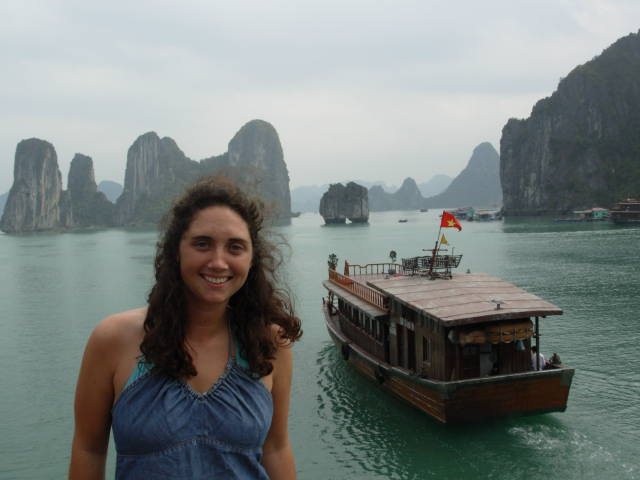
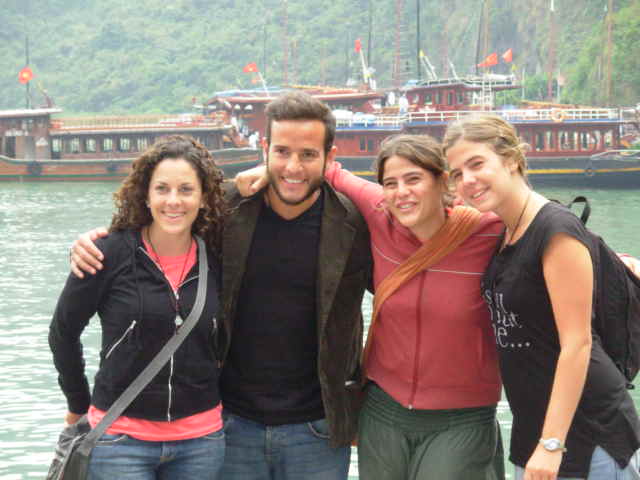
After flying from Hue to Hanoi; I met two people from Mexico City, Alejandro and Coral, on the shuttle from the airport. We immediately became good friends, and they invited me to joing them on a tour that they were doing to Halong Bay. We met up with two girls from Argentina, friends of Alejandro and Coral, and together the five of us left on a tour of the famous and beautiful Halong Bay.


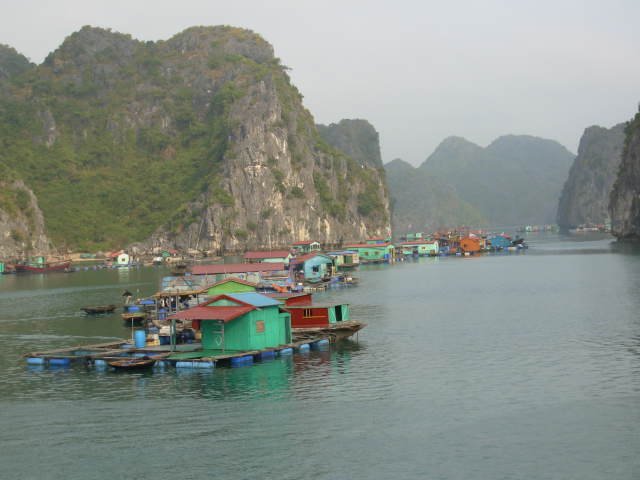
From the right: Coral, Alejandro, Vicki and her sister Clara. The five of us got along really well, and it was great to be able to speak Spanish with them, as it has been awhile since I've spoken Spanish for days on end.In Halong Bay people live on these floating houses. Women would approach our bigger boat in little row boats, selling food and beverages among other things.


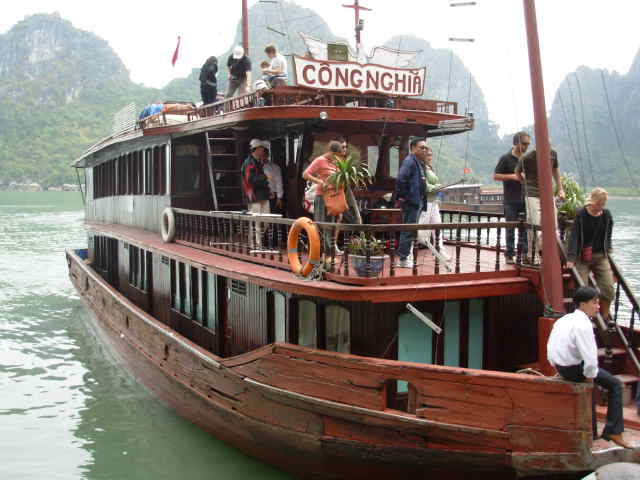
This was our boat, and I'm not sure what the name means. There were about 20 people in our tour group, but not everyone slept on the boat. About sixteen of us slept on the boat, and I shared a room with a girl named Pooja from India. Pooja and I get along really well, so we decided to share a room in Hanoi when we returned from Halong Bay. Pooja is a lawyer in Bombay, India.


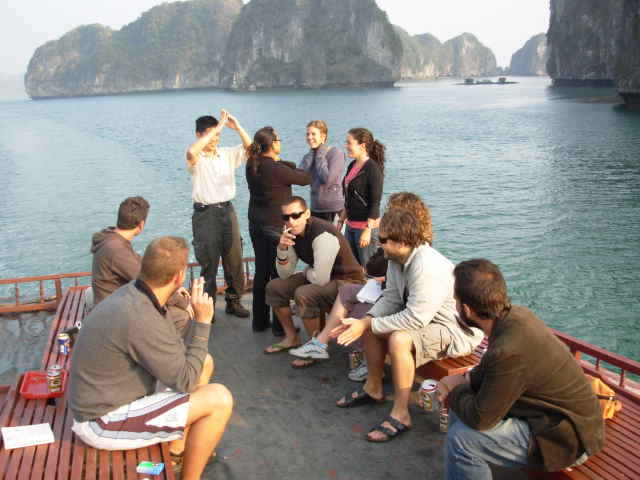
In the late afternoon as the sun was setting, we sat on the top of the boat, floating between these amazing rock formations that seemed to have grown out of the ocean. We drank some beer and stopped briefly to kayak, which was really fun! It was a great tour; I've returned to Hanoi and I will leave on a flight this evening for Kuala Lumpur, then Manil, then Hong Kong and back to Korea.

Tuesday, January 30, 2007

Phnom Penh, Cambodia

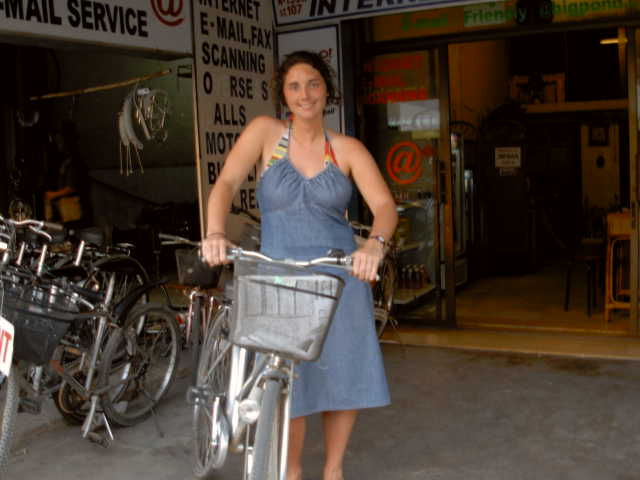
I rented a bike to ride around in Phnom Penh, but it was much easier than it looked! The traffice was crazy, and there are no sidewalks to ride on, so I had to ride in the streets with the motorbikes and obey all traffic laws as if I were a car or motorbike! By the time I returned the bike after two days it was definitely time!


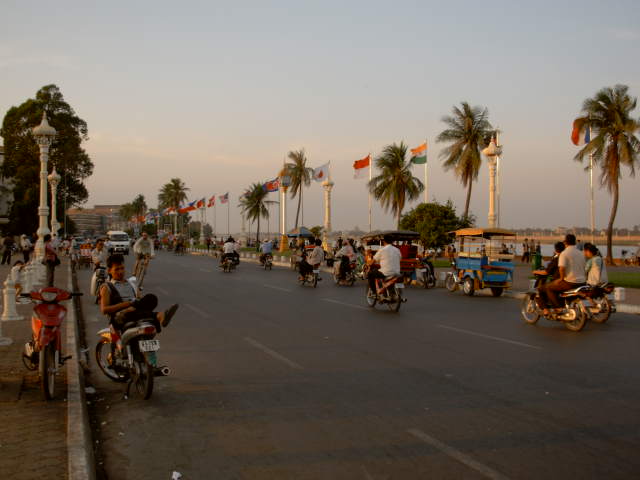
This is the street that runs along the river; sunsets were beautiful and everyone was out walking, eating ice cream, chatting; it was really nice.


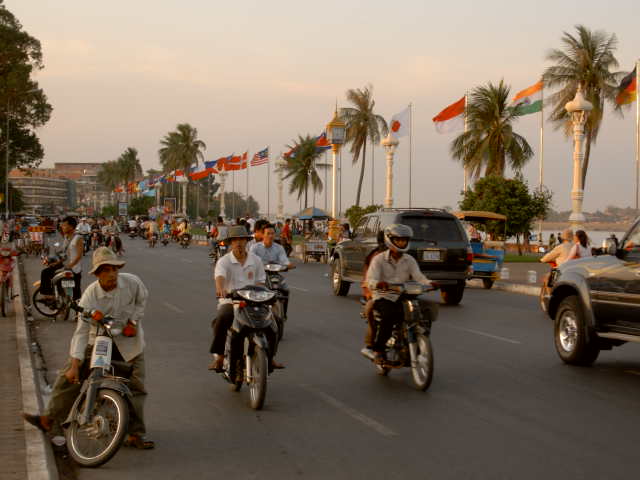
Here is a small example of the crazy traffic I'm talking about. There are hardly any stop signs or street lights, so if you want to cross a street, you just have to go for it! If you hesitate you're a goner, so you just have to go and everyone else will adjust to you.


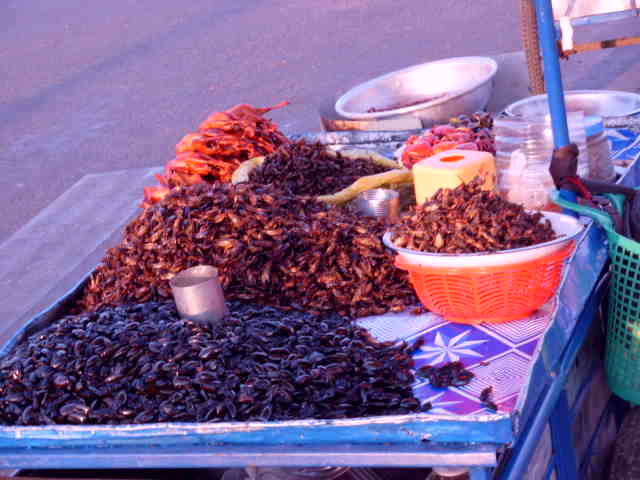
This is a typical Cambodian snack: bugs. Considering that I am not exactly a good friend to insects, these have yet to enter my mouth.


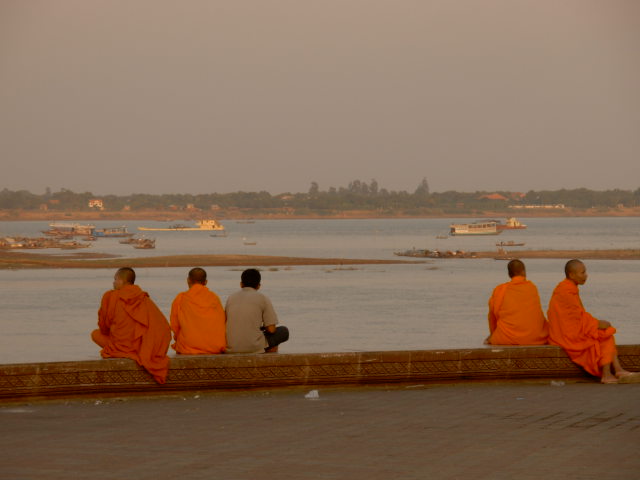
Some Cambodian monks by the waterfront at sunset.

The Ancient Temples of Angkor Wat, Cambodia

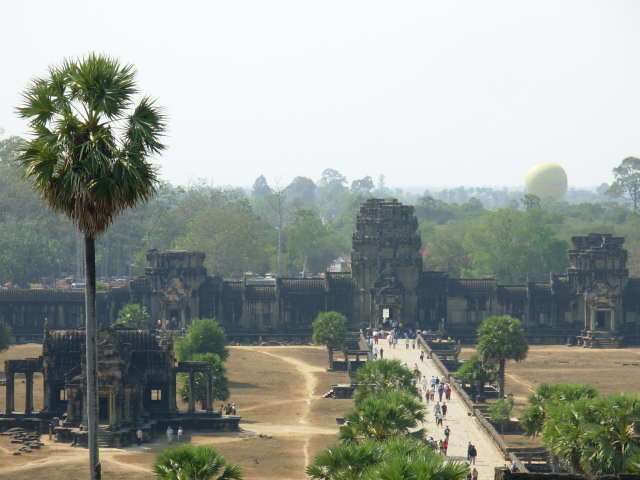
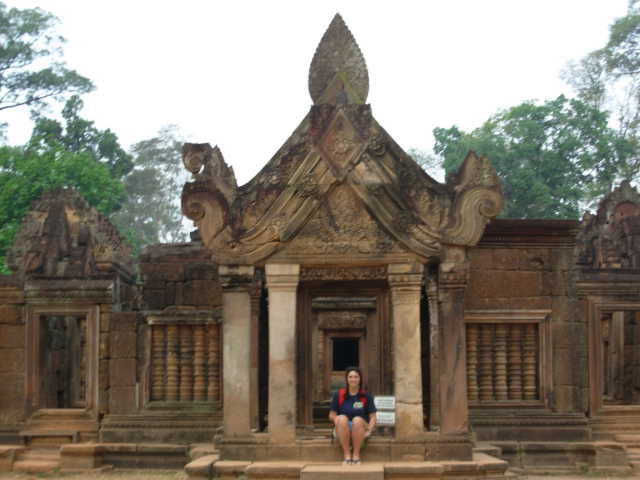
Angkor Wat temple is one of the largest. You can see all the tourists walking in and out; it was definitely a hot spot for tourism, but still beautiful.


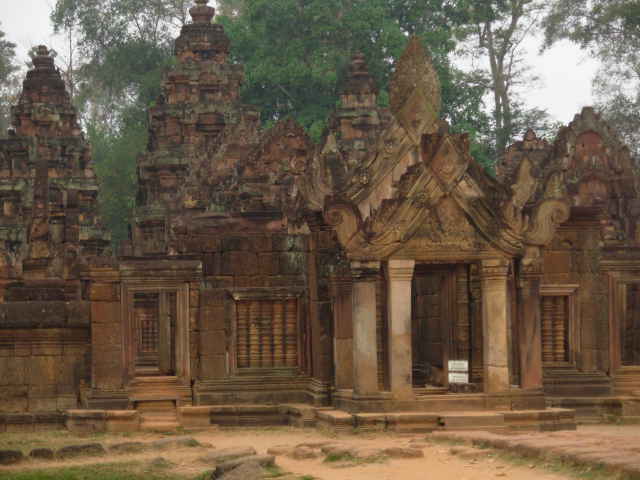
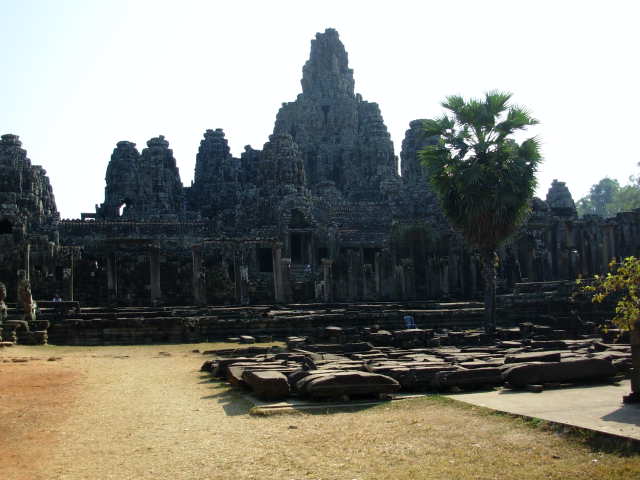
Another temple...
Here I am, hot and tired, but still happy to be at these amazing temples. There were so many temples that you could easily spend a week there and see all of them just once. I spent three days and say the most important ones.


Another temple...
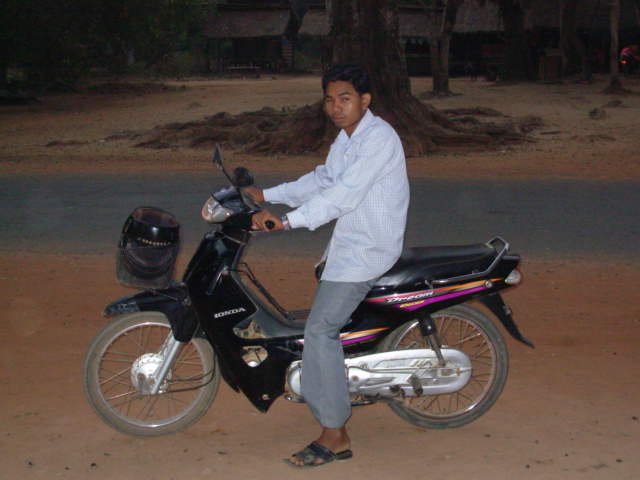
This was my moto driver. He was nice, but was definitely trying to rip me off at every turn. Maybe not rip me off as much as he wanted me to spend my money on his services and those of his friends, which were often not the cheapest available. His name is La and he's 26 like me.


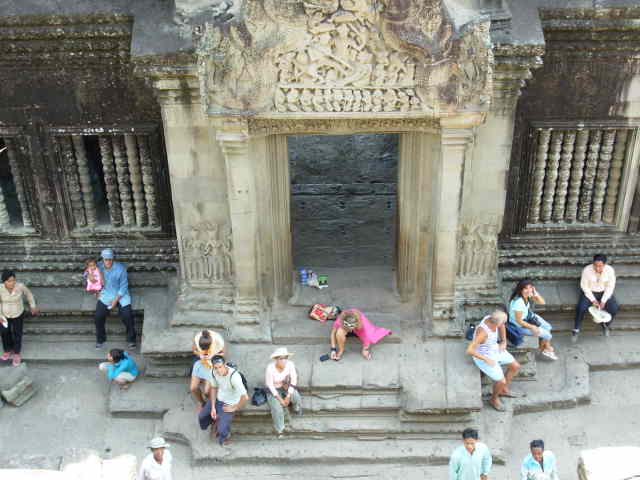
This is at Angkor Wat. You could climb up these very narrow stairs and look down on the temple. It was really beautiful, but the stairs are REALLY steep and it's hard not to get dizzy when you're coming down.

Monday, January 29, 2007

Mui Ne, Vietnam

I know that it has been awhile since I updated my blog, but I've been busy, I promise. I am in Vietnam right now, in a little beach town called Mui Ne. I am leaving in about an hour to head up north to a traditional village called Hoi An. Mui Ne is a beautiful little fishing village with a great beach and many people who have come to windsurf or kite surf, due to the heavy winds at this time of year. I arrived in Cambodia on the 20th of January, where I saw the ancient Khmer temples, which were really very spectacular, but there were a lot of tourists, so I only stayed 2 nights. I moved on to Phnom Penh where I stayed for 3 nights, and really enjoyed that city. I rented a bicycle and attempted to ride the streets of the city; however, it is much easier said than done, as traffic rules seem to be non-existent. I was in Saigon for 3 nights and met up with another American and a girl from Finland. We had fun seeing the sights and visited the Cu Chi tunnels, which are the underground tunnels where the Vietnamese hid out during the Vietnamese War, which is referred to as the "American War" in this country. These tunnels played a huge part in their ability to sustain themselves against U.S. troops, and they were really very intricate. If there's something I've observed about the Vietnamese, it's that they seem to be determined, efficient and quite clever (generally speaking of course). These tunnels were over 10 meters deep at places, they had different levels and trap doors, etc. to fool the U.S. troops. They were also very small so the U.S. soldiers had trouble getting around in them. After Saigon (also referred to as Ho Chi Minh City) I came here to Mui Ne and have been enjoying the sand dunes and the beach. I met a woman from the UK who I shared a room with, and some young French people who have been really great, so not to worry! There are so many foreigners traveling this beaten path that I rarely feel like I am on my own, at least not completely. I found that there were a significant fewer number of travelers in the Philippines, but both are nice experiences, just different. I will post some pictures as soon as I gain access to a better computer, as this one does not have the outlet that I need.

Tuesday, January 16, 2007

Where I'm headed next...
I realize that I've made exactly three blog entries in one day, after not writing for a week, and there are no guarantees as to when I will write again, due to the crazy schedule that I'm currently keeping, but if three entries is too much to read in one day, just read one, come back in a few days and keep plugging away at it until you manage to catch yourself up. In the meantime, it is very likely that I will not have written a new one so please, take your time. I just wanted to give a very general outline as to where I am headed next... I am flying back to Manila tomorrow morning for one night, then I will fly to Kuala Lumpur, Malaysia for one night, and onto Siem Reap, Cambodia on Saturday, January 20th. I will spend two nights, maybe three in Siem Reap looking at the ancient temples of Angkor Wat... I will then head to Phnom Penh on a bus and stay there for a few days before entering Vietnam. For those of you who were paying attention to what I might have told you when I was home for Christmas, yes... I did say that I was going to Thailand and Laos and I did not mention Kuala Lumpur. Thailand has been post-poned to a future date that could be anywhere from 6 months to 30 years from now and so has Laos...there just isn't enough time, and The Philippines sort of sucked me into it, in fact I could have stayed here the entire 5 weeks, but I am trying to strike a balance, by cutting out some, while still keeping other essentials. Anyways, I plan to be in Vietnam for two weeks from the 25th through the 8th, when I will fly back to Manila via Kuala Lumpur (don't ask; it was the cheapest flight available) and on February 10th I am off to Hong Kong for 5 days before landing in Seoul on the 15th and flying home to Jeju Island. My mother wrote me an e.mail and she had obviously been looking up some of the places that I have been visiting and she asked a very good question: "How do you choose the places that you are going to?" I am not sure I have an answer to that question... it ends up being a combination between amount of intrigue combined with feasability and speculation as to the amount of other tourists that will be there. The level of intrigue comes from what I read in my travel book and on the internet, as well as what I hear from other travelers, the feasability is in regard to amount of time it will take me to arrive and whether I can afford it, which in these countries I usually can, and I can only speculate as to how many other travelers will be there through what I read in the tourist book (Lonely Planet's Southeast Asia on a Shoestring). All of these work together also, because if there will be a lot of tourists, I may still go, but will try not to stay as long (this is the case with Angkor Wat) and usually the harder it is to get to a place, the less tourists that will be there. I also try to get as much geographical variety in a country as is possible in the amount of time that I have, in order to expand the scope of my overall experience. I know that this sounds very scientific and in fact it is (I use an excel sheet, to plug in the figures and determine my next destination, just kidding). It is a good question, and it's funny, because usually what happens is that I think I know where I'm going and then I speak with someone who says it's raining there, or there are tons of people, etc., so I change courses, but once I decide for sure, there is nothing stopping me from getting there. It becomes a mission and no matter how many hours on the top of a jeepney or a winding rough mountain road, there is NOTHING that can stop me from getting there. I do have moments when I sort of have these slight out of body experiences, (an exaggeration, but the best I can explain it) and I'm sort of looking down at myself laughing... because I'm not sure it's worth it... the sunburn, the strenuous transportation, not being able to stop and urinate for hours, the smells, the sickness, whatever it may be...all to see some rice terraces and an underground river that I could've looked up on the internet, but it is the journey itself, the adventure, that I find the most intriguing and maybe the most rewarding, so I just keep on moving and each destination that I arrive at only makes me hungry for more.
My fellow Korean Residents

It's interesting, because no matter how long you live in a foreign country, you're still never "from" there, especially when your physical appearance or accent so blatantly gives you away. You live your life as a "foreigner" or a "westerner" (in Asia) in the culture, even after you've learned the language! That is all relative to the fact that you were not born there and the natives/locals were; however, when you find yourself in a country that is neither theirs nor yours, suddenly you are brothers, or at least you find yourself with a sort of kinship that had never been previously tested. For example, I have run into many Koreans (this is a hot travel spot for Koreans I'm learning) and when I meet them, I feel close to them in a way that I do not in Korea and I think they feel the same. Suddenly it becomes very apparent that although I will never be "Korean" I am still much more "Korean" than someone who has never been there, and especially someone who has never lived there. It goes beyond the fact that I know what Koreans eat and some of their language, in the past few months I have been immersed in their culture and they know as well as I do that I understand them better than the average person. In fact many Koreans come off as sort of abrasive, egotistical and even a little annoying (I've found this out through talking with some of the Philippinos that I've met.) It's funny, because I can see how an outsider might think that; however, it takes the kind of cultural experience that I've had to look past those things and see how it all fits together, how you can't have the good without the bad and they are all inter-connected to a history that is very different from my own or the Philippines. I can sympathize with Koreans in more way than one, because I'm constantly encountering the same experience as an American. Most of the people I meet have never been to the United States and don't want to (almost out of pride); the people to which I refer are mainly Europeans. The other night I had dinner with an Austrian couple that I had been scuba diving with and I provoked a political discussion, by asking many questions about Austria's government, which in turn led to a discussion about the USA. The woman in particular had a lot of animosity towards the USA and I sat and listened patiently while she basically preached every stereotype in the book as if it were the gospel... and as she went on about the fat Americans who only eat junk food and live in a society that is NOT diverse OR free...I mean you can't drink until you're 21~ and in order to get a VISA to visit the USA you have to tell them how many times you go to the bathroom everyday...etc., etc. She went on and on...and on... and I let her, but I definitely realized that this woman was in fact an outsider. If she had lived in the USA, yes she probably still would've held many of those views; however, I can only hope that she would have at least understood a little better that what makes us bad also makes us great, that it's all inter-connected and there is not country that is perfect, not even Austria. America has become a sort of international punching bag and although I don't think that it is totally un-deserved, I also wish that people would acknowledge that there is an America which they fail to see, in fact refuse to see. The night before that encounter I had dinner with a Korean couple who I had gone scuba diving with. The man lives in Pusan and he was a Korean physical education teacher in a middle school. We were able to talk and joke and compare notes on the customs and culture of Korea and they were both amazed at what I knew in the way of customs (thank you Fulbright). I felt very close to both of them, and grateful that I'd run into them and they seemed to feel the same. When you realize that you don't think like an outsider, you realize that you are in fact an insider, almost by default, because I certainly don't feel like one in Korea, but relative to everyone else I think I qualify.

Palawan Island, The Philippines

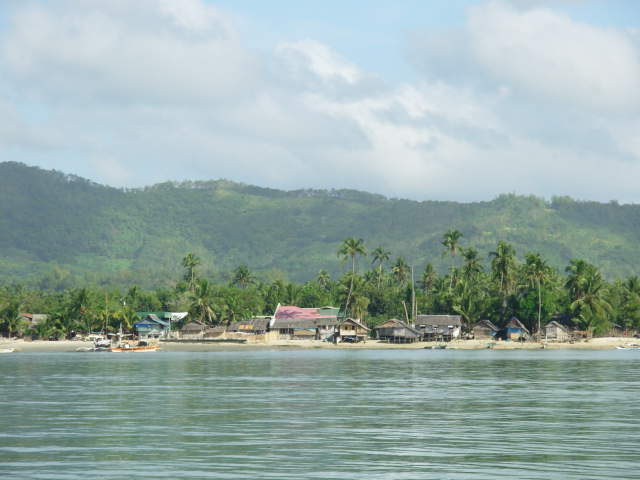
Here is a typical beachtown, this one is called Roxas on Palawan Island, and it was where I caught the boat to Coco Loco Island Resort, where I spent the last four days.


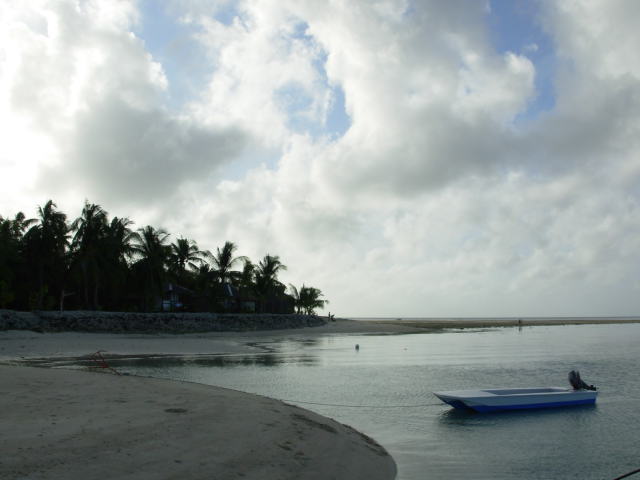
Here is a picture of Coco Loco Island; it's takes about 15 minutes to walk around the entire perimeter of the island... and the resort and the dive shop are the only things on the island. I spent the days lying in my hammock reading, scuba diving every morning, and eating delicious food!


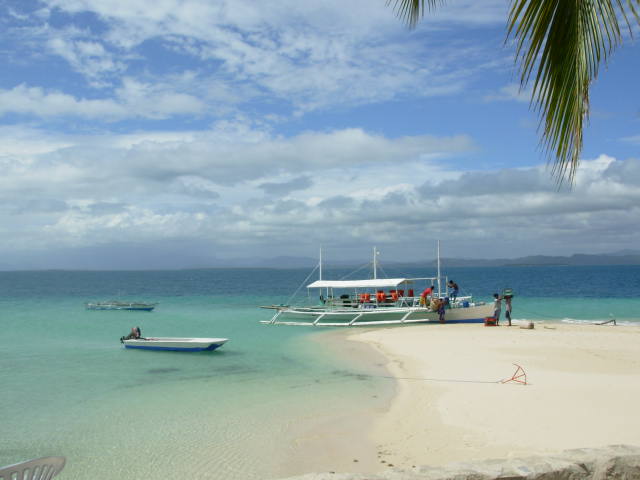
I took this picture sitting at one of the dining tables on the beach! It was such a great place to stay. The meals and the lodging (a sort of cabana with a mosquito netted bed, bathroon, and a porch with a hammock right on the beach.) The resort has about 20 cabanas, and there were probably about 15 other people there with me while I was there and about as many staff members not including the scuba diving guides. Every day you just had to tell them what you want for breakfast, lunch and dinner (dishes ranged from vegetable curry with rice, to fish steaks or chicken in a spicy coconut sauce) and what time you would like to eat... it was REALLY relaxing. There was no internet and no phones! Your only responsibility was to relax and enjoy yourself, which I definitely did!


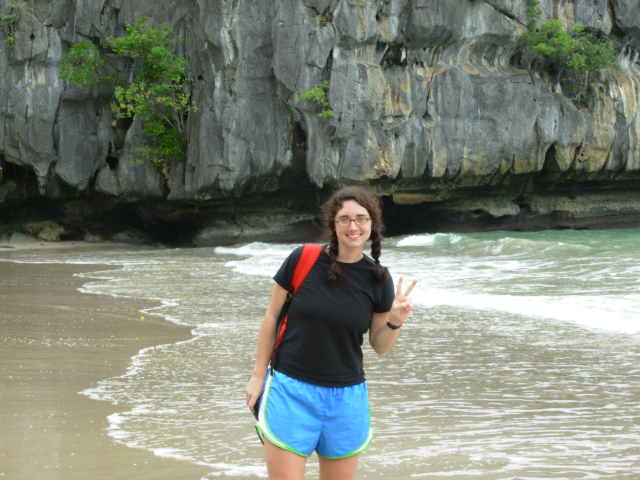
Here I am outside of the Underground River in Sabang... it was pretty amazing! I've never seen that many bats in my life; the cave was pitch black and we were in a paddle boat (5 of us and a guide)... it was thrilling to say the least. I was at the front of the boat holding the flashlight which was connected to a sort of car battery through jumper cables, and I tried not to think about what would happen to us all if we turned over and were in the water with that battery. Anyways, because I was holding the flashlight all the bugs and the bats were sort of dive bombing me...good thing I was wearing a helmet...


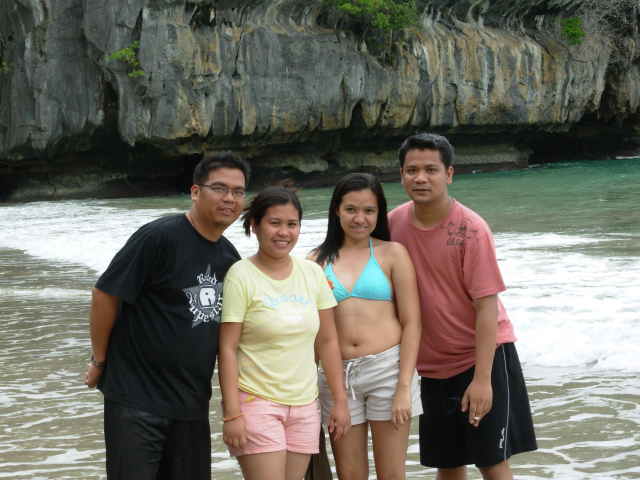
Here is a picture of the four Philippinos from Manila on vacation. I went with them in the boat, etc, because you paid per boat. Afterwards they bought me lunch and gave me a ride to my next stop... very, very nice, and I hope to return the hospitality if and when they make it to the USA!


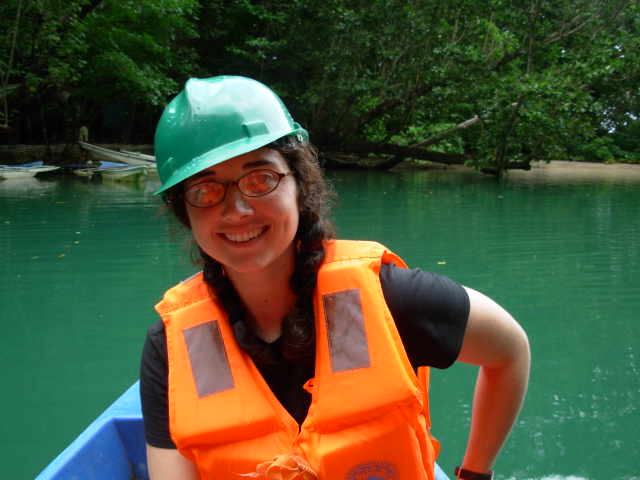
Here I am in the nifty hard hat that kept me from being grabbed by little bat feet, and kept me from the other various droppings that fell from the ceiling of the cave, not limited to condensation if you know what I mean...


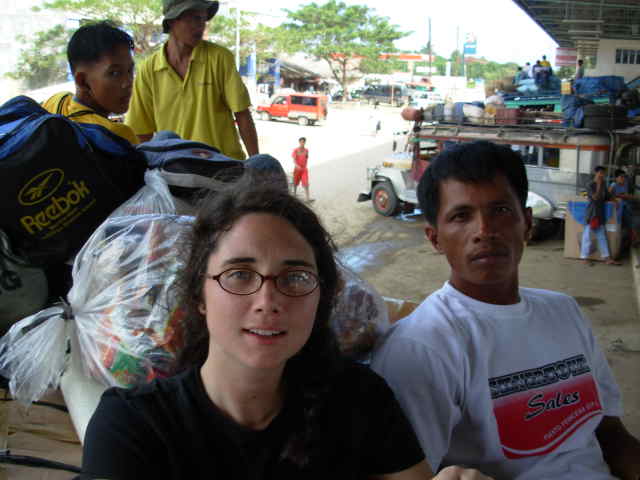
Here I am on my first day in Puerto Princesa (the capital of Palawan). I rode on the top of a Jeepney (you can sort of see one in the bag right corner of the photo) piled high with luggage and boxes, along with 15-30 Philippino men (it ranged because people kept getting on and off.) The road was hideous and the ride took about 3.5 hours, many times we were not traveling at much more than 20 miles per hour. The men were all really nice to me; they seemed to get a big kick out of having a foreigner traveling on the roof with them... they gave me the best seat: a bag of rice to sit on... I was traveling in style and luckily the sun was behind the cloud most of the ride, otherwise I would've ended up bright red, instead I was just slightly pink by the time we arrived in Sabang (this is the town where the Underground River mentioned above is located.)

Tuesday, January 09, 2007

"What are you waiting for?"

The bus ride from Baguio to Sagada was an 8 hour field trip through the Cordillera Mountains. I did nothing but peer from my window at the outside world resembling nothing I have seen before. The highway we were on was the only road that serviced these tiny mountain communities which at first look seemed to be self-sustaining. In reality self-sustainable is relative to the level of poverty that exists here; they aren't anywhere near having all of their needs met, but I there is nothing other than farming creating wealth in these communities, aside from the occasional bus that may or may not stop at the little stands on the side of the road where they sell crackers and other convenient store products for 10-20 pesos each (20-40 cents). As we rolled through town, heads would turn and people would shake their arm to get a ride (or maybe they were doing this for the entertainment value); if they were lucky our driver would stop, but most of the time he moved on, because we were too crowded, or maybe just because he felt like it, I'm not sure. Our bus also seemed to function as a sort of postal service. We took one large package from an old woman and 3 hours later the bus boy stopped at a little store that was not opened and leaned the package up against the wall before jumping right back on the bus, no payment ever changed hands on either end. (the bus boy acts as the driver's assistant, jumping out of the bus to tell him when to stop when he's backing up, and to put the make-shift emergency brake under the back wheel, something that looks like a hammer with a huge rock head.) As we traveled through these towns, what really struck me was the amount of people whose faces peered back at mine. These people were just sitting by the side of the road, or walking or just standing, or just looking. Basically, these people were not doing anything. What struck me as ironic is the amount of time that they have. I mean they don't have a job to be at, they don't have a school to go to, they don't have money to spend, food to eat, and heaven forbid they go jogging or do anything that might expend extra calories that they don't have the food to replenish. So it's best that they just sit there, chat with friends, watch for buses to wave at, toss stones at the ground, sit around a pile of burning trash to keep warm. What I find ironic, is that although they have no money, they have time. And in America, where money is plentiful, time is something that has become invaluable. In America there are beautiful houses with flat screen T.V.'s and plenty of other entertainment equipment, computers, and beautiful kitchens, left empty all day and part of the night while Americans are out doing what they do: being productive. I tried to picture one of the Philippino families let loose in a house like that just for the day, perhaps they would still just sit around and chat out of habit. Today my tour guide, Derrick said to me: "You're lucky that you can travel." His words were different than if they had come from another American, but at first my reaction was the same as if an American had said it, because I immediately thought about how lucky I was to get the time off to travel for two full months in the middle of the year, but what he meant was that I have the money to travel. Derrick told me he would like to travel to the United States. And hearing Derrick say that was different than if another American had said it, because it's not like when you hear a co-worker or a friend say something like: "I've always wanted to go to Greece or I've always wanted to learn how to cook". The most appropriate response is: "What are you waiting for?", and although we often say this to our friend or co-worker, we both know that time is what is lacking, but when Derrick told me that he really wanted to go to America, to Houston to be exact, I did not respond with "What are you waiting for." Because we both know what Derrick doesn't have: the means.

Rice Terraces, Banaue, Philippines

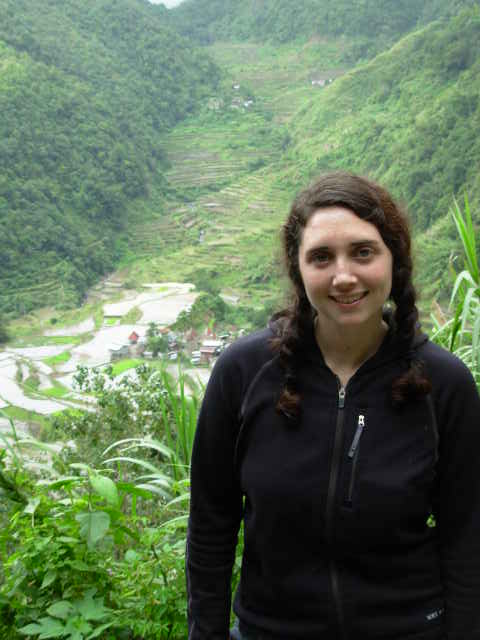
My guide (the mountain bike driver) took this picture. He waited for me at the bottom while I hiked for 4 hours! Tomorrow he will show me some hot springs and more rice terraces before I head back to Manila on the night bus (a ten hour ride on bumpy roads). Part of the reason I took this picture was to give my family back home proof that I am still alive!

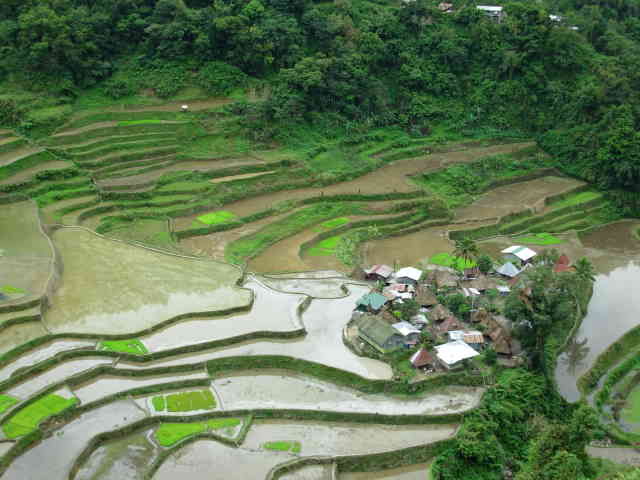
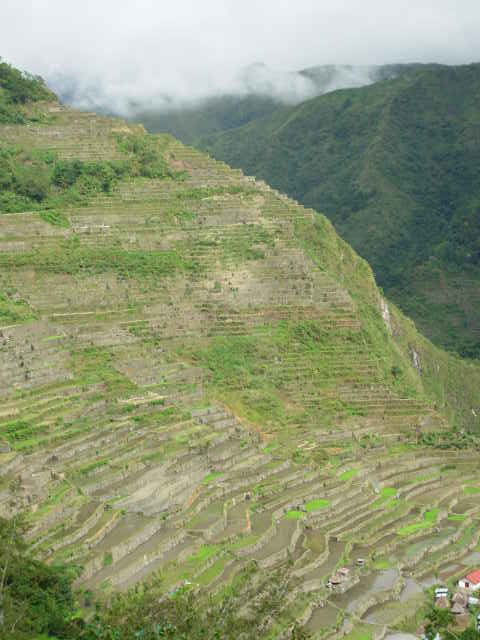
I hiked to these rice terraces, tucked deep in the mountains. My journey began in the side car of a "motorcycle" which is much more like a mountain dirt bike (the wheels are that size). I spent an hour in the side car, then my guide, Derrick, parked it and I hiked up over a saddle and down into a small town called Batad, where I had a great view of these rice terraces, the tallest in the region.

Here is a little town called Baranguay (at least I'm pretty sure that was the name, give or take an "r".) The people in the small town farm the surrounding rice fields. Each one is owned privately; a family may own 3 or 4, but they work together to farm them. The amount of rice that they farm only make up a portion of the amount of rice it takes to feed the village annually; the rest they buy from neighboring provinces. I thought they produced rice to sell, but I was wrong.

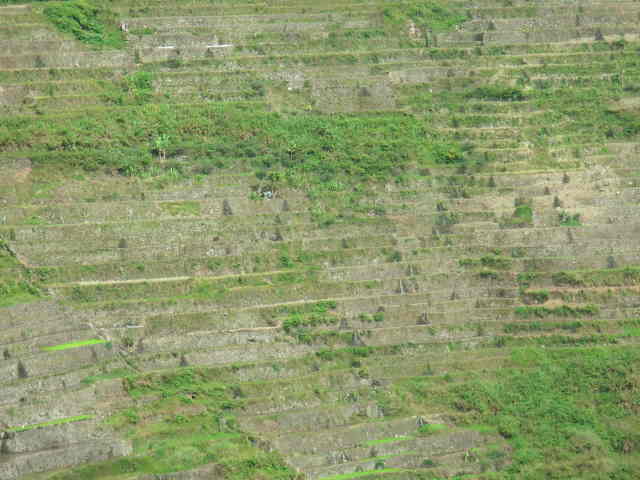
An upclose look at the Batad rice terraces... they're really quite exquisite.

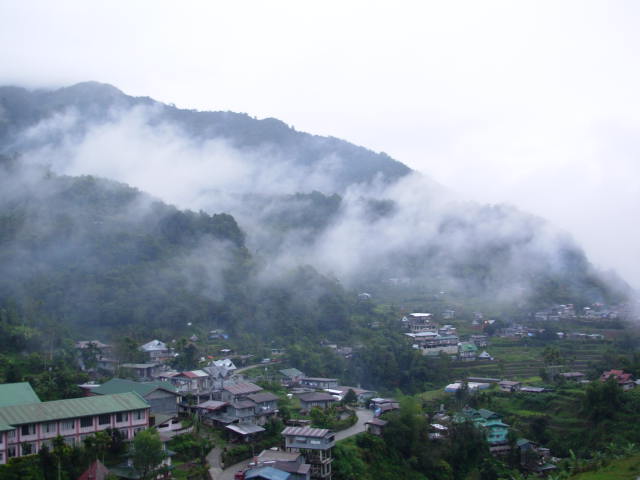
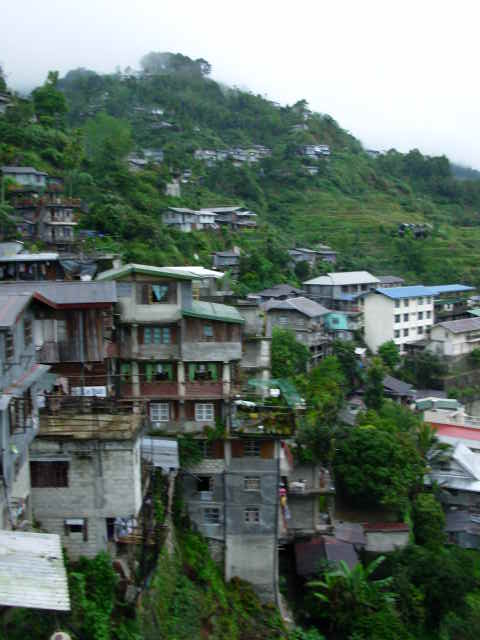
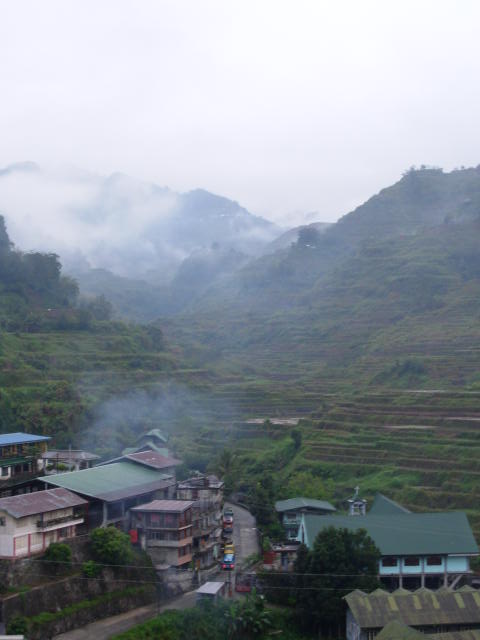
Another view of the town where I am staying: Banaue.

This is a side view of the town of Banaue. My hotel resembles these concrete structures from the outside, but is quite cozy and warm inside.

The view from the balcony of my room! The fog in the morning was so thick that I could see nothing but clouds from my window.

Monday, January 08, 2007

UPDATE...

I know that it has been over two weeks, maybe even longer since my last blog... a lot has happened since then. I went to the United States to visit my family and friends over Christmas and New Year's, which is part of the reason I didn't write at all... I have A LOT of family and friends... (just kidding, I don't have that many of either, but it still felt like an insufficient amount of time to spend with the people that I have missed since being in Korea.) On January 4th I returned to Korea for about 12 hours, before boarding a plane for the Philippines, where I am presently. I arrived on Friday, and it has been quite an adventure. This is the first decent internet cafe that I have encountered, and it could very well be the last, so I'm not promising anything after this entry, but I'm going to try very hard to update on where I am and what I am up to. At this moment I am sitting in a town called Banaue, which is tucked very high in the Cordillera mountains and it was quite a journey getting here, but it was well worth it. My days begin at 6am and I'm asleep by 9pm, sort of like camping. I have time to read, write, and attempt to plan out where I'm headed next. I have a hotel room that overlooks the Ifuago rice terraces, which are exactly what I came to see. Tomorrow, weather permitting, I will hike further into the mountains to get a better look at these spectacular rice terraces (sort of like shelves in the side of the mountain, carved 2000 years ago). I am very excited to take some pictures and post them! I arrived here this afternoon after a 3.5 hour journey in a vehicle that is referred to as a "Jeepney". As I have been told, Jeepeys only exist in the Philippines, in fact they are made here, and they are these long covered jeeps where they stuff about 12-20 passengers (the more the merrier seems to be the opinion of the drivers). It cost me around 3 dollars to get here from the town where I stayed last night called Sagada. In Sagada I saw hanging coffins, which are exactly what comes to mind: hanging coffins. These coffins are attached to the side of a mountain, rather than buried beneath the earth; this was the practice before Christianity came to the Philippines. The dead bodies were bond in the fetal position before putting them in a somewhat small wood coffin (representing the cycle from birth to death). In order to free the spirit they hang the coffins on the side of a cliff wall, or put them in the light, because light represents goodness, whereas criminals and other "evil" persons were buried on the dark side of the mountain or deep in a cave. These coffins really were worth the 8 hour bus ride on the windiest, steepest road I have ever driven on, in a bus crammed 5 people to a row. The bus ride to which I refer was from a town called Baguio, which is not where I originated... I came from Manila the day before on a 7 hour bus ride which wasn't that bad; however, I arrived here with some sort of stomache sickness which has yet to be diagnosed, which made that bus ride seem a little more hairy than it was. I even had an unfortunate experience in the ladies "restroom" at the bus station in Manila before departure. Luckily, I awoke this morning feeling much better, and I am happy to report that I am able to hold down solid foods, although my appetite is not exactly what it used to be. Now, I know that I have probably thoroughly confused you by telling my story backwards, and I promise to do a better job on my next post. I will give a few overall comments about the Philippines. It reminds me much more of South America than it does of Asia, and I am sure that is mostly due to the fact that it was colonized by the Spanish. The people here have been very very kind and they speak incredible English! The local dialect is an intresting fusion of Spanish, English, and Philipino. Tomorrow I will attempt a hike to the rice terraces and perhaps a waterfall. On Thursday I plan to head down to the islands and experience the tropical islands and scuba diving that I have read a lot about!

Monday, December 04, 2006

"Sorry, I don't English."

I walk home from school everyday around 4pm. This means that the only other people who are out on the streets are middle school and elementary students, and they all love to wave and say "hiiiiii" to me. I walk with my earphones on, but can usually spot them and lift my hand to wave fast enough that it's not considered rude. Sometimes I don't notice right away, but eventually realize that there is a small group of 5 year olds across the street in a huddle shouting "hi" at me. To this I always respond with a loud "hello" over the traffic that separates us, causing them to giggle in unison. All of this has become part of my daily routine; in fact, it would feel strange if I walked home without so much as a glance from the kids in the street. Today I was leaving my high school and I saw a group of about 7 middle school girls from the same school that my younger host sister, Sue Jeon, goes to. These girls were about 5 feet in front of me, and took turns twisting their necks in my directions and smiling with a small wave and a "hiiiii". I of course, did my normal wave and "hi" in response, but I decided to ask them if they knew my sister Sue Jeon, as they looked about her age. In Korea you can't just ask someone if they know Go Sue Jeon, because that would be like asking if they know John Smith times five. I noticed the other day when I was taking roll with my students, rather than two or three Smith, Anderson, Martinez or Hernandez last names in a classroom; there are like 10 Kims and 7 Gos, etc. This means that there are really only 5 last names that the whole classroom splits and some of the more popular names, like Kim Soyeon, have one per class at least. Instead of asking these girls if they knew Go Sue John, I asked them what class they were in, because my sister is in the second grade. I thought I could narrow it down from there; however, when I asked slowly and clearly: "What grade are you in?" The girls' faces showed nothing more than blank stares, if anything they just looked puzzled. From my point of view, I don't understand why it's puzzling that when you wave, stare, and yell "hi" to someone repeatedly in the street they strike up a conversation with you. I asked again and the girls stopped, still puzzled, but smiling. Finally one girl held up her hand (as if to say "stop") smiled, scrunched up her nose, and in a sweet voice said: "Sorry, I don't English." To this I responded with sincere comprehension: "Oh, you don't English."

An Old Tree, Snow, Quail and Archery on Sunday

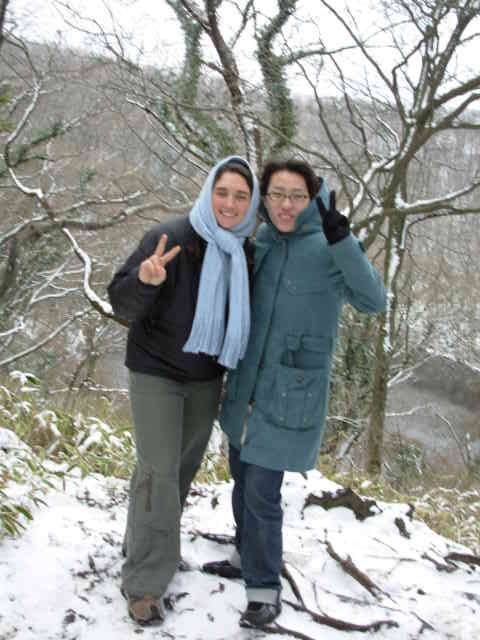
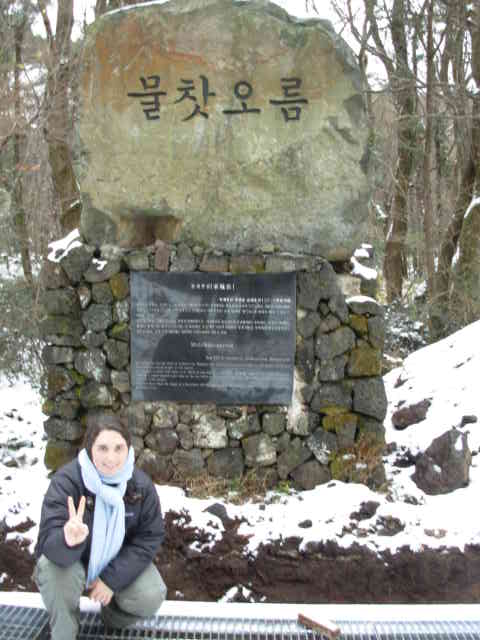
The head teacher of the second grade wanted to take me to see some of the special tourist attractions on Jeju Island, so he enlisted my friend and fellow English teacher, Soyeon (she is two years my junior), as a translator and we set the date for Sunday December 3rd. I was told that we would go hiking and then do some archery. So at 10am we were off! First we drove away from the coast, towards the middle of the island and as we did we gained in altitude; this meant that the rain became snow, the first time I've seen snow on Jeju Island.


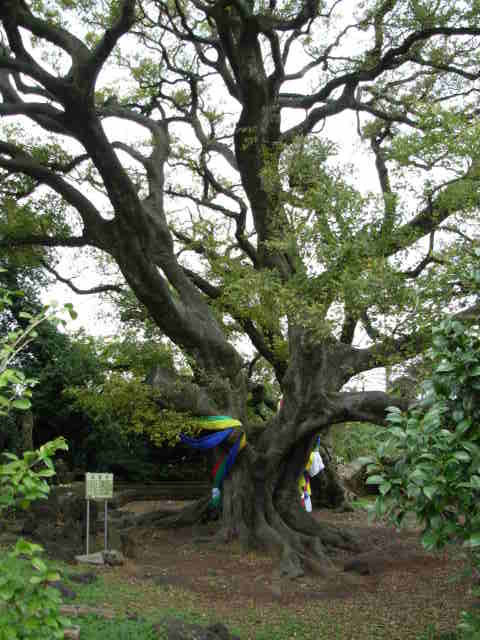
Our first stop was the oldest tree on Jeju island (over 400 years old). After snapping some photos of the tree, we drove a little further, eventually arriving in what felt like the middle of a forest. I could not believe I was still on an island; we had been transported to a winter wonderland.


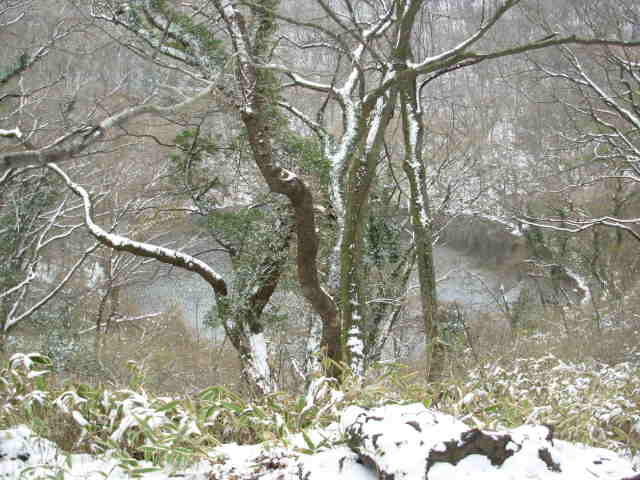
As we hiked through the woods, I enjoyed the silence that is so rare in Korea. The birds, bugs, animals, even people were all hiding away somewhere warmer, as our shoes crunched the snow and our breaths froze in the air. We were hiking a "small mountain", in Korean they're called "Odums" and there are 360 of them on Jeju Island. Odums were formed from lava when the island itself was formed, the largest "odum" being Halla Mountain itself. Each odum has a crater at the top of it, but the odum that we saw today is the only one that actually has water in the crater.


After the hike we enjoyed a lunch of quail, which was the best quail I've ever had. We dipped thin slices of raw quail into boiling water for a few minutes and then into a sort of wasabi/soy sauce mixture before eating them...it was really good. At the end of the meal we had soup and noodles.


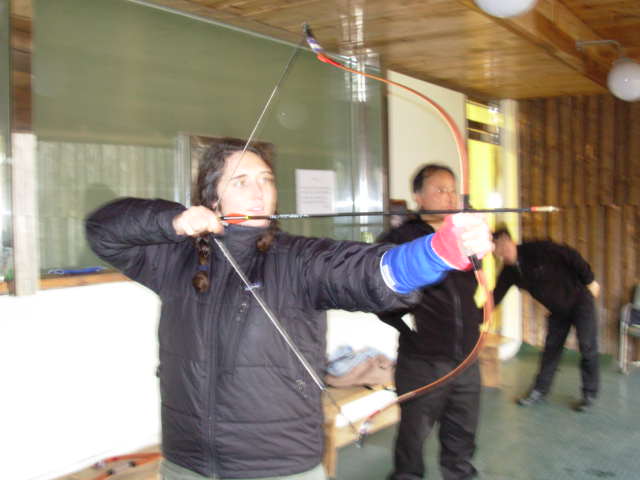
After lunch we headed to the traditional archery place, which turned out to be sort of like a shooting club, but for archery. It was a really nice facility and the teacher was very patient with us.


It was a lot harder than it looks; I was just happy when I could hit the board, let alone the bull's eye. After I all my arrows had been shot for the last time, Mr. Kim handed me his last arrow and I shot it right into the target. I was pretty excited and so was everyone else; it was a good ending to a great day!

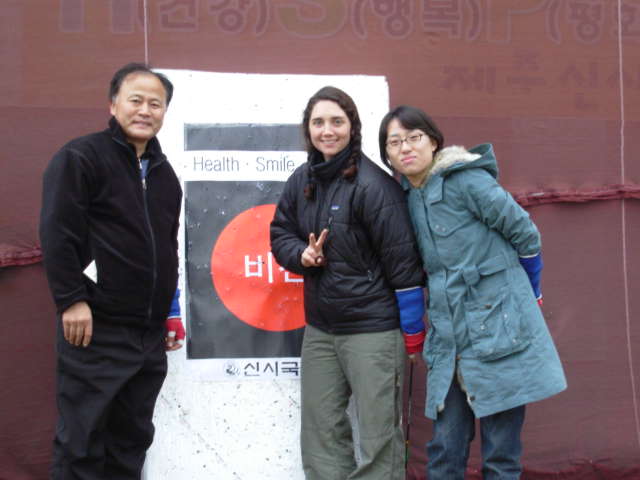
On the left is Mr. Kim, me and Soyeon. You can't see it, but in the picture is the arrow that I shot right into the target on my last shot for the day!

Sunday, December 03, 2006

Joongang Girls High School Winter Festival 2007

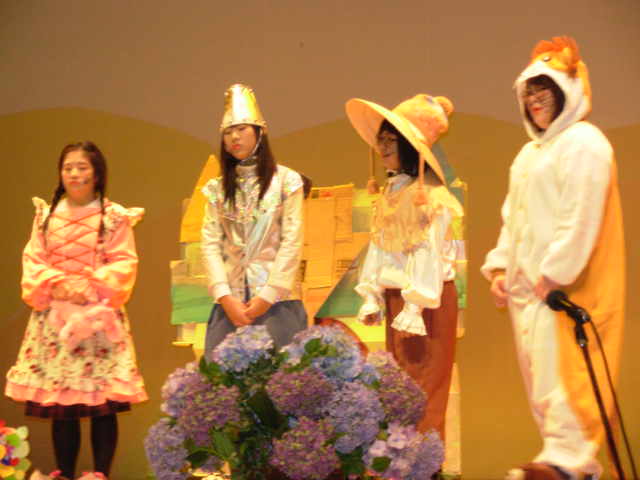
Friday and Saturday we did not have school, instead we all went to a nearby event center to watch the 2007 Winter Festival, which was put on by our own students. This event really cannot be compared to anything in the U.S.A. It's not a Christmas pageant (it's too long for that) and it's not quite a pep rally, but it's sort of something that falls in between the two... In fact the winter festival was composed of two plays (Wizard of Oz and Cinderella), a Japanese, Chinese and English speech contest, a guest lecture by an alumni, a couple of performances by parents (dancing and a fashion show), guest performers from other schools who sang and danced, multiple performances by the dance club, another play about bullying in schools, a chorus competition between all of the 30 classes (10 classes in each grade), numerous singing competitions, a talent show, and lots of pep and school cheers interspersed throughout. I know you may be asking yourself: "How long did it take to do all of that?" The answer is: 13 hours on Friday and 8 hours on Saturday with a one hour break for lunch on both days. The students (all 1200 of them) basically sat in their seats the entire time. I'm not even sure they were allowed to leave the auditorium, because there were girls standing at the doors. My sister, Eunae, is part of the student association so she was very active and busy running things and even hosting part of the show.


Dorothy, the Tin Man, Scarecrow (Eunae) and the Lion from the Wizard of Oz. At one point Dorothy said "F#$! you!" to the wicked witch; all the girls in the auditorium got it but luckily my principal nor any other teacher heard or understood the meaning.


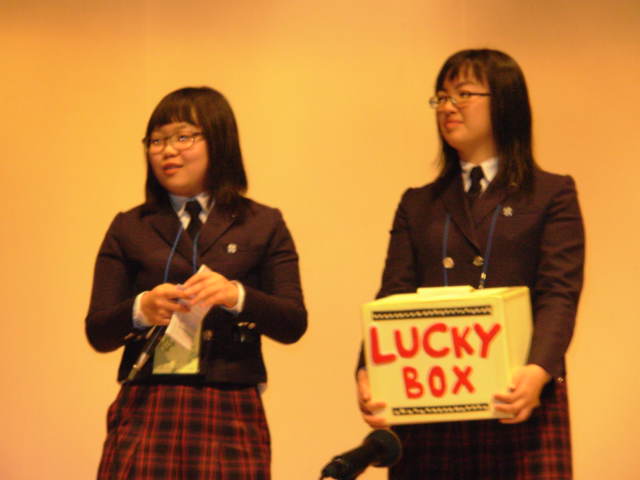
Between performances, they would pull out the "Lucky Box" and call a teacher up to the front to pull a name out of it; the winner got movie tickets. I was called up twice, the first time because my name was on the list and the second time because the girls started chanting my name. It was a little daunting to realize that 800 of the students in the autditorium (2/3) were my students! Eunae, my sister, is the student on the left. I think the "Lucky Box" was the students' favorite part of the program, because they would chant "Lucky Box" at every little break, sometimes even during the program...


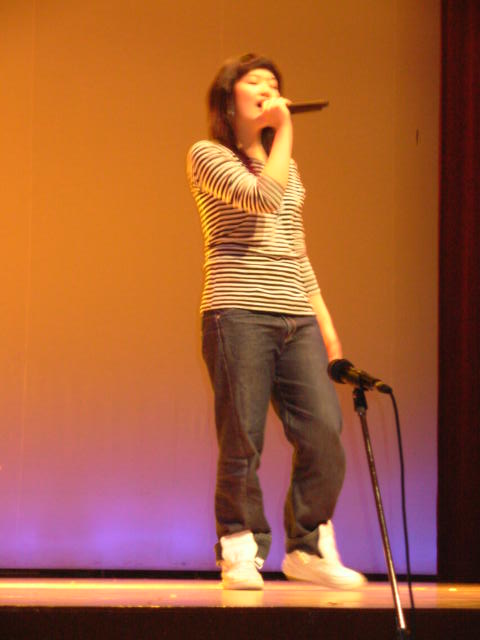
One of my 2nd grade students singing an English pop song...


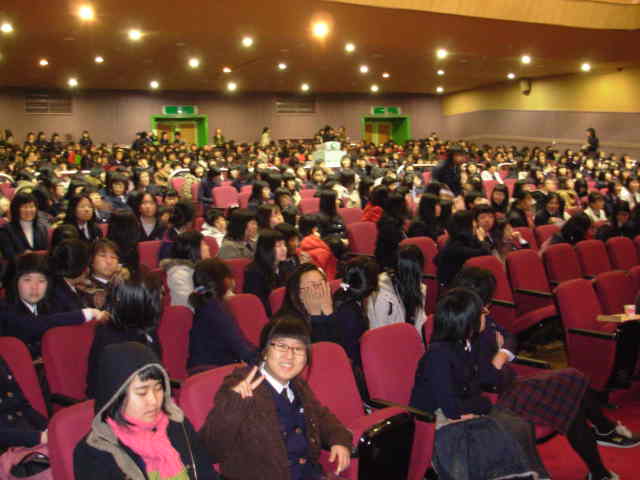
This is what the auditorium looked like. All the teachers' seats were in the front two rows, which was nice for the teachers; however, it also meant that the students were left to do be as noisy as they saw fit.