Friday, May 11, 2007

Photos from Sports Day!

The man with the cap gun is the P.E. coach for the school, a really funny guy. Here the girls are doing the final relay race, and you can see that at least 3 of them do not have shoes on. This contributed to a few injuries on the track; at least 5 girls slipped and fell down, getting trampled by the other runners.

This is one of the classes doing their aerobics routine. Female teachers judged them on their aerobics skills.

The girls had pom-poms and empty water bottles that they banged together as they cheered on their classmates. Team 8 won the cheering competition, because they were relentless. They cheered all day long, barely stopping for lunch!

Jumping rope was more difficult than it looks. The entire class goes through one at a time, without missing a beat, then they go through in doubles (holding hands), then triples, then groups of four, then five. This is class 2-7, one of my favoriet classes!

Badminton... a very popular game among girls in Korea... sort of like field hockey in the USA.


here is class 2-7 again. They were happy to pose for a picture...


The whole school doing the aerobics routine together, first thing in the morning.


Here I am with another favorite class. These girls have snow white on their t-shirts. Each class was in charge of designing their own shirts.


Here are more of my students... you can see that a few of them are wearing the towels on their heads to keep the sun of their faces...

Sports Day at Joongang Girls High School!!!

Today was Joongang Girls High School's Sports day! For the past few weeks, I've heard about "Sports Day" otherwise referred to as "Field Day," but because Korea never ceases to surprise me, I still had no idea what to expect. In the end, Sports Day reminded me of camp, Jesse Owens Day from elementary school and a birthday party all at the same time. Yes there was competition, but nothing like the level of competition that we have in American high schools. Korean teachers and students kept asking me what games we played at "Sports Day" when I was in high school, and I had to say that we didn't have a day like that when I was in high school. The main reason being that none of us were deprived of sports and recreation on a daily basis, so there was no need to designate one day out of the school year to practice recreation. I played sports everyday after school and sometimes before school (basketball freshman year). I had to tell them that the closest thing I could compare it to was the track and field day that we had in elementary school, otherwise known as "Jesse Owens Day," but even that was more serious than today's sports day, because it was actual track and field competitions like long jump, 50 meter dash, etc. and we won medals and trophies. Today's activities included the following events: tug-of-war, dodgeball, badminton, a relay race, aerobics, jumping rope and cheering. Today was about games more than it was about sports. I showed up at school in my sweatpants, t-shirt and tennis shoes; whereas, many of the girls who ran in the relay race were not even wearing shoes (at least half ran around the dirt track in their socks.) I was ready to participate in whatever sports might be required of me, but I never even broke a sweat. The day was kicked off by an all-school showcase of an aerobics routine performed by the entire school (1200 students). While they performed the routine, the principal and teachers sat in the shade on the newly built deck observing them. Then everyone separated and competed in the events that I listed above. Each class was a team and competed against the other teams; they wore t-shirts with their team numbers on them and cheered all day long for their teammates. At one point the teachers played dogeball and tug-of-war against the parents (about 20 parents showed up to volunteer). We beat the parents in dodgeball, but lost to them in tug-of-war. I also was able to practice jumping rope with one of my favorite classes. I was very happy to see my students in t-shirts and sweatpants, getting dirty and enjoying themselves in the sun. It's funny though, there's no such thing as a "healthy tan" in Korea. These girls were deathly afraid of getting ANY sun on their faces. Some had towels wrapped around their heads and held in place with a clothespin under their chin. Most girls wore big straw sunhats and applied sunscreen throughout the day in order to keep their skin fair. I spent all day walking around, cheering for my students and enjoying the weather. At 4pm Sports Day ended with an awards ceremony... and guess what the students won? What do you think they give the winning teams on Sports Day in a country where toothpaste and detergent are often given as party favors at wedding? If toilet paper came to mind, then you are right on! For each event that they won, students were awarded with a huge Cosco sized package of T.P.! The funniest thing was how excited it made the students (it is highly coveted, because the bathrooms do not have toilet paper in them.) Some teams won as many as 5 events, therefore ending the day with 5 huge packages of toilet paper, probably totaling around 100 rolls! After the awards ceremony the parents held a catered party/dinner for all the teachers in the school cafeteria, where we toasted our school with soju and beer. At 6pm I stumbled home, feeling exhausted from the sun and soju, happy to see my students leaving school too, one of the rare days where they were able to leave school before 10 or 11pm.

Wednesday, May 09, 2007

My Trip to Busan

I just returned from an amazing trip to Busan, South Korea's second largest city, located on the southeast coast of the country. It is only a 50 minute flight from Jeju City to Busan, and I had mid-term exams (which meant no classes for 6 days) so I took off to the mainland for a vacation. I met four friends in Busan: Sara, Janaki and Jy as well as the ETA who lives there, Rohit. As a city, I prefer Busan to Seoul; Busan is on the ocean (Korea's largest port) and there is a more relaxed feel to the lifestyle and bustle of everyone's daily lives. We visited two big beaches that easily rival Jeju's most secluded ones, and both were surprisingly clean, especially considering they were so urban. After four days in Busan, I went with my friend Janaki on a 2 hour train ride to the town where she has been living: Gumi, South Korea. Gumi is known for its facotories and blue collar atmosphere, but it was a really charming little town. It was nice to see how my experience could've been much different if I had been placed in a different area, especially on the mainland. Janaki teaches at an all boys high school, so I went to school with her to see what it was like. All boys is a far cry from all girls! The boys were very cute and fun, but also much louder and harder to "talk over" than my girls. Janaki has a very nice homestay family who lived in the USA (Salt Lake City) for a year in 2001. Now I am back on Jeju Island. Tomorrow, Friday, is "Sports Day" at my school, and I'm not completely sure what that means, but I will find out soon enough. I will post pictures from that as well. In one week I am headed to the USA for a mere 3 days, to attend my cousin's wedding in Napa Valley, CA. I am very excited to see my family!

My homestay father works in Busan and lives there most of the time (he flies home 2 times a month for a few days). He works at a horse racetrack in Busan, and he was kind enough to renta condo for me and my friends to stay in one of the nights that we were in Busan. He also took me and my friends out to an incredible sushi/sashimi dinner and for coffee afterwards.


Gwangali Beach, one of the beautiful white sand beaches in Busan. At night this is a hotspot, especially on weekends. There are vendors walking around selling fireworks (roman candles mostly) and people are shooting them off continuously at all hours of the night. The bridge in the picture is a famous bridge in Busan, and Gwangali Beach offeres a beautiful view of it when it's lit up at night.


This is a temple that we visited on Saturday. It is really amazing, because it's the first temple that I've visited that is built on the rocks next to the ocean. Saturday was Children's Day in Korea, so everyone was in great spirits and the temple was really crowded with tourists.


Sara and I posing with our Starbucks lattes, a rare find in South Korea (at least in the places where we live). In the background is Haeundae Beach, an upscale area beach area which hosts many Japanese tourists. We were lucky to stay in a condo near the beach on Friday night (my homestay dad rented it for us).


A view from the other side of the bridge and two of the Haeundae condo buildings. We stayed in a building similar to this one one night. We also went to the sauna (steam room/hot baths) on teh 5th floor with windows that looked right out onto the ocean, it was really nice.


Sara and I practicing some of the poses that are so common among our high school girls and other Koreans. The hand covering the mouth is a particularly common pose for Korean high school girls. I think there are two reasons they do this: to make their jaw/face appear smaller and to symbolize how shy they are.


A kimchi vendor at one of the markets... who knew there were so many different kinds of kimchi?

Saturday, April 21, 2007

Fulbright Review Article

Below is a copy of the article I recently submitted to the Korean Fulbright Review, a collection of writing from all the Fulbright researchers and ETAs who have spent the past year in Korea on a Fulbright grant. I wrote a blog entry that this article was based on; however, I thought I would publish this final version as well.

밥 먹어요 (I eat rice.)
By: Jennifer M. Anderson

“Do you like rice?”
It’s a question I don’t recall answering before coming to Korea. If I had been asked my answer probably would have gone something like this: “Well, I don’t not like rice, but I would never choose to eat it. When I have to eat rice, I prefer brown rice, and sometimes I don’t mind it when it’s part of a sushi roll but the rice itself, no. I guess I don’t really like rice.”

It took me very little time to realize that in Korea this answer is unacceptable. My first lesson on rice came on my first day of school. We were standing in the lunch line when my co-teacher popped the question. At the time, I was naïve enough to think he wanted an honest answer, so I said, "No, not really." To this he muttered "huh" under his breath and scooped a huge portion of rice onto my tray. "Rice is good for you; it keeps you from getting fat." When I responded with raised eyebrows, he continued, "People in places like Africa, China, and India eat rice and they're not fat." In my mind I was laughing. Here was a man who had solved America’s obesity problem by way of simple observation. Now all he had to do was tell the rest of the world! I could imagine Mr. Hyun selling his diet to thousands of Americans with a slogan like: "One cup of rice per day keeps the fat at bay."

I am living proof that Mr. Hyun’s theory is incorrect. Rice doesn’t like me as much as I don’t like it. Those small white grains do little more than convert themselves quickly into glucose, eventually surrounding my middle as if in organized protest against my body. Nonetheless, Mr. Hyun’s response to my casual dislike for such a bland food caused me to think twice about my answer to his question. It wasn’t long before I had changed tactics completely. The following day when I was confronted with the question, I could hardly leave enough time for the inquisitive mind to finish before blurting out an enthusiastic “Yes!” “Oh yes, I like rice!” Suddenly I was consumed with the desire to shout it at the top of my lungs, sing it as if it were the chorus to my life!

This brought about a new problem altogether, as I feared an overly observant person might notice the small helping of rice on my tray and ask the obvious question: “If you love rice so much, why don’t you eat more rice?” I’ve thought about this, and formulated a response in the case of such an emergency: “Because good things are best when enjoyed in small quantities.” Fortunately my skillful maneuvering of the rice particles on my tray and slow eating tactics have shielded me from this follow-up question.

You might ask yourself why I’m still in the closet about my blatant dislike for rice. I’d be lying if I said I hadn’t asked myself the same question. Koreans are proud of their rice, it invades many aspects of their lives. A Korean meal is not a meal without rice. I often find myself at a restaurant, stuffed full of meat and side dishes, when the waitress arrives with a tray of steaming white rice, like a recurring nightmare only I’m not dreaming.

I have been told that eating rice at every meal is a practice resulting from a time when there were food shortages in Korea, a way of showing that Koreans do not take rice for granted. Perhaps you have heard the greeting "Have you eaten rice today?" For me this question has never radiated warmth. When I first heard it, I was horrified that Koreans would actually police the consumption of rice. I was worried my charade might finally be found out. My panic turned out to be in vain, the question was nothing more than a greeting leftover from a time when rice wasn’t as plentiful.

Korea’s relationship with rice has led some to assume that bread is to America what rice is to Korea. It is true that there are some similarities between rice and bread. For example, the way Koreans call all bread, “빵” whereas, we differentiate between cake, muffins, bagels, and so on, but consider rice to be rice. Still, bread does not play the same role for Americans that rice does for Koreans. In fact, many Americans, myself included, prefer not to consume carbohydrates at their meals at all.

Perhaps you have to experience Korea, to understand how my answer to a question as simple as “Do you like rice?” can change from one continent to the next. In reality it’s a different question altogether. In Korea, “Do you like rice?” is not a question regarding preference, but one that deals with culture. If it were about preference, there would be no right answer, and no reason to modify my answer. For a foreigner in Korea, though, there is only one right answer. The right answer is most definitely a nod in the affirmative unless you want to be outcast and grouped with the foreigners who came here to make money, the foreigners who aren’t interested in Korean culture, who don’t try to speak Korean, the foreigners who date their students and travel in packs. In Korea, this question is not about rice; “Do you like rice?” is about Korea and how open you are to this experience.

I’ve never liked rice, not Spanish rice, not wild rice, not even fried rice and especially not white rice, but in Korea I eat rice. I eat rice every day, at almost every meal even breakfast. This is one of many small concessions I’ve made in my daily life in Korea, and I am motivated by a basic human desire: acceptance. Eating rice is one of the ways I can show Koreans that I am willing to approach this experience with an open mind.

I remember a time when I witnessed a first meeting between my mother and one of my brother’s college girlfriends. She hardly looked my mother in the eye, didn’t shake her hand, hardly glancing at us while we stood talking to him. We all knew that it was a temporary relationship, but it was troublesome nonetheless. In Korea eating rice is one of the things I do to show Koreans that I care. The amount of rice I’ve consumed is tangible evidence of how much I care. I’m not going to lie, when I return to America, I may never eat rice again, but for now 밥 먹어요.

Bio:
Jennifer is originally from Roswell, New Mexico and received her B.A. from the University of Denver in Creative Writing and Spanish. Jennifer currently teaches English at Joongang Girls High School in Jeju City on Jeju Island. In July Jennifer will return to the United States to begin law school in the fall.

Tuesday, April 17, 2007

Virginia Tech and South Korea

Today I walked into my classroom and a table of students were whispering with worried expressions on their faces.

Finally they looked up and said:
"Jennipa, umm... Virginia Tech....we're sorry."

I was a little puzzled, because the way they said it seemed to be a personal apology, as if it were somehow their fault. Then I remembered that the gunman was born in South Korea. I thanked them for their apology, but they went on:

"South Korean blood... Americans... will think...immigration bad.... Americans not like South Koreans. "

To this I replied as simply as I could, because of the language barrier:
"But the gunman was crazy, that is unrelated to the fact that he was South Korean; I think most Americans will realize that."

And they said:
"But American newspaper, ABC, headline said: 'South Korean Gunman kills 32'"

I was surprised by their sincerity and shame, because it was as if they were apologizing for something that they themselves were responsible for. My initial reaction to their apology was shame for my own country. I was ashamed to think that they would assume that Americans were so quick to judge. I told them that I didn't think Americans would blame an entire country for a violent act that was carried out by a former citizen; however, in the back of my mind, I thought it was possible that they'd raised a valid point. hated to think that our country had gained a reputation for making such sweeping generalizations and placing blame on immigrants and foreign nationals. My students actually expected American immigration to refuse entry into our country due to this atrocious act by someone who happened to be a foreign national from South Korea.

At this point it hadn't occurred to me that there was something else at play here which had nothing to do with America and everything to do with Korea. It is why many Korean-Americans in our Fulbright group were warned upon arrival that their life could very possibly be much harder in Korea than the rest of us. It is why in my classes, no student wants to sit at a table by themselves, even if it's just by chance and doesn't mean anything, nor do they want to call out the answer if they're the ONLY one who knows it. There is a collectivism in Korea that as an American is hard to understand, because it links everyone together, making conformity the ideal and everything else undesireable. This is one of the biggest cultural differences between Korea and the USA. In Korea you're either in or out; if you can't be defined as Korean, then you should be clearly recognizable as a foreigner. America is composed of immigrants and foreigners from all over the world. If an American had done something similar in a foreign country, I would feel horrible, but I wouldn't be ashamed, as if it were someone related to me by blood who had shamed my family and our name. Here there is a different mindset about what it is to be a Korean, and a sense of pride that comes with being Korean. A Korean is a Korean and nothing can change that, you either are or you aren't Korean, and there are certain expectations that come with being a Korean. These expectations are linked to everything, from the way you walk to the way you talk, dress, and act. It is not O.K. to be a Korean and not fit the mold.

The shame and apologetic attitude that I found in students and teachers at my school today was not limited to my school and my city; I have heard accounts of similar reactions from Fulbright teachers around the country. Many Fulbright teachers have been taken aside and offered sincere apologies for what happened. Another similarity is the tendency for Koreans to refer to the gunman as Chinese. It's bizarre, because everyone knows that he's South Korean, and although there may have been a short amount of time when it was unclear exactly what his origin was, his name is distinctly Korean and it has been verified that he is indeed from Korea. Still, when I arrived at school this morning, my co-teacher said, "I'm very sorry for what happened at Virginia Tech..." I said thank you, and she went on,"especially when I heard he was Chinese." To this I raised my eyebrows, saying, "you mean South Korean?" and she said, "oh, yes, yes." It's almost a subconscious way of dealing with the shame, trying to re-categorize him or disown him. I'm not saying that my co-teacher actually believed he was Chinese, I'm not sure why she said that, but it's interesting, because other Fulbright teachers have reported similar experiences where teachers referenced a Chinese gunman rather than a South Korean.

Later, when I checked my e.mail and read that there was a rumor (started by a Korean radio station in L.A.) circulating about how the parents of the gunman had committed suicide, it seemed like yet another way of trying to diminish this intense shame that has caught South Korea by surprise. It also seems like an assumption that Koreans would make, because in a nation where your repuation is everything, the logical thing to do when faced with such unbearable shame would be to take your own life. Another Fulbright teacher reported that a teacher told her the gunman had committed such a horrible act because of his "American way of thinking." I also think this is a result of the shame, a way of rationalizing it or trying to make sense of something that is almost impossible for a Korean to believe that another Korean would do.

The fact is that this young man was deeply disturbed, he must have been, or he couldn't possibly have done what he did. The sad thing is that he had no help, not from his parents, not from professors, not from the school, not from other students. This in no way means that he was justified for what he did, nor does it mean that it could have been prevented, but it is a sad situation for everyone involved. Sadder still, is how we forget about these things, as if they're minute details not even worth mentioning, but do not hesitate to make this mass murder into something more political (i.e. gun control, immigration, etc.), more personal (South Koreans thinking that they are to blame and me being ashamed of American prejudice) instead of realizing that the event is simply tragedy at its worst, not preventable, perhaps not even understandable; the most appropriate thing to do is not to argue, not preach, not rationalize, not blame, but simply to mourn.

Miscellaneous Photos

Last Saturday night I had dinner at one of my co-teacher's houses. She made delicious abilone soup, and I met her husband and little girl (who is about 2 and a half). My co-teacher goes by the name "Jennifer" also, but her real name is: Kim Hyun Sook. Here I am with her and her daughter. After dinner the four of us went to a "nore bang" or "singing room," where they seemed to be overly impressed with my ability to belt out 80's pop songs from U2 to Starship.


Kim Hyun Sook's daughter (English name: Hillary) and husband (English name: Benson). Benson recently applied for a VISA to visit the United States, although he's not sure where he wants to go yet. He did say that he would like to come to Denver and possibly New Mexico this summer and see me if I'm there. Benson is a professor and writes editorials for the Korean Herald.


Kim Hyun Sook's daughter and I really hit it off. She's as cute as can be. She especially enjoyed playing the pointing game where we went over the words for things in Korean and English. She actually seemed to grasp the concept that something can have two names, one English and one Korean.


Fellow Fulbrighters, experimenting with three chopsticks...it's harder than Janaki makes it look, let me tell you. It was sort of a contest, and it caught on quickly, although it probably wasn't that appropriate considering we were in a nice banquet room with an extravagant buffet in a 4 star hotel.


Sunday, April 08, 2007

HAPPY EASTER!

Here I am with three of my favorite students! They asked me to take pictures with them last week outside of school. This was a suggested pose... now that I see the picture, I'm not sure I had it exactly right.
This is the view of Halla Mountain from our school (the mountain that I climbed a few weeks ago). Also, the cherry blossoms that you see on the other side of the athletic field are in full bloom right now, and they are everywhere! It really brightens up the island!

Saturday, April 07, 2007

Happy 80th Post!

Wow, I just realized that this is the Blogging Buddha's 80th blog post! I don't know why that's exciting or even worth mentioning, but it's a little ironic, because I haven't been very good at writing on my blog in the past few weeks. I knew it had been awhile when my father sent me an e.mail asking if I had "writer's cramp." He was just kidding, but it still reminded me that I have not written anything almost three weeks. It's also quite a coincidence that the Blogging Buddha's 80th blog birthday falls on the same week as my Grandfather's 90th birthday! Actually, that's not really a coincidence, because the two events couldn't possibly be more unrelated; however, I wanted to wish my Grandfather a "Happy Birthday" from Korea, and that was the best literary transition I could think of. "Happy 90th Birthday Grandpa!" A few thinks have happened since I last wrote on my blog. Last weekend I attended my last Fulbright workshop. All 70 Fulbright teachers came to Jeju Island for the weekend and we stayed at a very posh hotel on the other side of the island. It was really fun, because the point of the workshop seemed to be socializing and little more. We spent the weekend singing karaoke, trying to teach ourselves how to eat with three chopsticks (more difficult than it sounds), and lounging in our hotel's over-priced coffee shop with a great view (one person would order a $7USD coffee while the rest of us hovered around the table, enjoying the spectacular view of the ocean.) Monday I returned to Jeju City and was informed that I would have a "preliminary black belt test" the following Sunday (today). I spent all week training for this morning's test, which they told me would be harder than the actual black belt test and if I didn't pass, I wouldn't be able to test for my black belt in June. (when I say that they told me this, I mean that they looked up words on the internet and I used those words to guess what they were trying to tell me, but what I'm trying to say is that there was a lot of reading between the lines on my part.) This morning I got up early and one of my instructors drove me out to an abandoned hotel, where I realized all of the other kids in my class had spent the previous night. The test itself was quite interesting. The minute I got out of the van I had kids hanging themselves out the windows yelling "Hiiiiii" to me. I didn't realize that it would be other Tae Kwon Do gyms as well as my own, so most of the kids had never seen me before. I was constantly surrounded by kids who were intent on testing the following English phrases out on me: "What is your name?" "You are pretty." "You are tall." "What do you like?" "How are you?" and "He is crazy!" (the last phrase seemed to be their favorite, and they would yell it while pointing at one of their friends.) The age range of these children was 7-12 years old. In order to understand what my morning was like, you must close your eyes and picture an empty room. Then fill that empty room with 100 children ranging in age from 7-12 years old. Each child is wearing a Tae Kwon Do uniform that looks as though they have not taken it off in a week (one boy had his pajamas on under his uniform.) They are all running around this big room, as if they have been spoon fed sugar for breakfast. Some kids have others pinned on the ground, one boy was is laying on his bag while his friend drags him around by his Tae Kwon Do belt, others play tag, and then there is me, sitting in the corner, surrounded by a dozen or so children who are staring at me and practicing what little English they know. Now picture ten Tae Kwon Do teachers walking the room, chatting to one another, oblivious to the chaos that surrounds them. That is what my morning was like. I just tried to survive until they blew the whistle and lined us back up to do our poomsaes and eventually take our test. For those of you who don't know, a poomsae is a sequence of punches, kicks, and blocks that you must learn in order to attain your black belt. There are 8 of them, and they generally get harder as the number goes up. (The hardest part for me is keeping them all straight.) As we got ready to take the test, each of my instructors approached me with two thumbs up, and said: "Fighting" (I think this means: "You can do it!") I felt a lot of pressure, especially because I knew my instructors were nervous too. Luckily, I didn't let them down. I did my poomsaes and at the end when the judges (very serious men in suits, who seemed to have been flown in for the occasion) were giving us all their critiques, they said my name, "Jennipa" followed by: "Very good." I felt as light as a cloud; it was like finding out I had won a Fulbright grant all over again. I rode home in van with 25 screaming children, and the whole time I could only think about those judges and the "very good," that they presented me with. It was better than a ribbon or a trophy, it was verbal praise from a Tae Kwon Do grandmaster, which seems to be a rare find. I am now halfway to my black belt; my next test will be in June.

Sunday, March 18, 2007

Winter Climb: Halla Mountain for the second time...

I have been meaning to post these pictures for the past week, but I've had a cold and just didn't get around to it. Anyways, last Wednesday I didn't have school, so I decided to climb Halla San (Mountain) for a second time.) It looked very different, because there was snow at the top and the lake that is inside of the glacier was frozen over. I decided that I'm going to climb it again in spring and summer as well, in order to see it in all 4 seasons! Here are some pictures from the hike:

Here I am at the top! I met the nicest Koreans on this hike! The whole time they were giving me fruit and other snacks to be nice. I think they were surprised to see a woman hiking alone, but at this point I don't think they're too shocked when they see foreigners doing things.


This is what the lake at the top of the mountain looks like! Halla San is a volcano, so the crater at the top is from the erruption years ago...


This is a picture of the types of picnics that Koreans have at the top of the mountain. I am always amazed how everyone tends to pack the exact same snacks: peeled cucumbers (to prevent dehydration), rice cakes, kim bap (like a sushi roll, but with egg and ham instead of fish), hot water for tea, fruit, and sometimes soju (alcohol) or makali (traditional rice wine).


I took this picture before I reached the top; it's the last leg of the hike.


Tuesday, March 13, 2007

Korean Life as I've Known It

I have officially been back on Jeju Island for almost a month now. I have been teaching regular classes for a little over a week, and life has quickly returned to "normal." I say this in quotations, because life in Korea is anything but normal when compared to the way I've lived the previous 25 years, but things have returned to the way my "normal" Korean life was before winter vacation, with a few minor exceptions. My classes are going really well; the girls are as enthusiastic as ever. Today one of my co-teachers commented, almost suspiciously: "All the girls really like you." I said, "Oh, I'm glad." And she continued as if I hadn't gotten her point, "I mean, when I ask them if they like you they all say "Yes!!!" like this," and she threw her arms up in the air to demonstrate. This makes me feel good, because I like them too. I'm sure there will be the normal troublemakers, but generally I fell that I have finally achieved a balance of mutual respect between student and teacher in the classroom. It's important to me, because it's what I remember most clearly about the relationships that I shared with my favorite teachers (not to mention, it makes teaching a whole lot easier.) I am back on my daily schedule which consists of jogging, Tae Kwon Do, teaching, the internet and reading (not a bad life). My Tae Kwon Do class has changed slightly, because it is much larger and the children are in fact children (like the age that I would normally babysit.) This means that instead of the refreshing "I'm too cool for the foreigner" attitude I got from the 12-16 yr. olds with whom I shared the class last semester, there are now 30 highly energetic, cute and very-excited-to-have-a-foreigner-in-their-Tae-Kwon-Do-class kids between the ages of 7 and 12. Luckily, I still have a class on the weekends for two hours on Saturday and Sunday with the aforementioned high school students, where we actually do Tae Kwon Do. The weeknight classes have helped me discover other talents that I didn't know I had, like dodgeball and hopping on one leg (the sole purpose of that game is to see who can do it the longest.) I'm not sure if I should go back to America and join a professional dodgeball team just yet. I try to remind myself that I am the tallest and oldest person in the room by at least double, but everytime I catch that small rubber ball, I can't help but think I might have a rare gift that has previously gone unnoticed. Tonight when I walked into the Tae Kwon Do class I caused an uproar; all I could hear were little squeals of "Jennipa, Jennipa, Jennipa!" Most of the kids I didn't even recognize, because I've only been to this class maybe twice before, and I don't even recall telling them my name. I couldn't help but smile when a chubby boy, who couldn't be more than 9 years old, approached me and said very gravely: "Hello, Jennipa." From his voice you would think that we were in one of those black and white movie s, and he was an old lover that I hadn't seen in years. I have tried to imagine how I might have reacted at 9 years old if, one day a 7 ft. tall Brazilian man suddenly showed up as a student in my after school ballet class. When I think about this, their reactions to seem much more ordinary. Sometimes I feel like I have so little time left in Korea! I tell myself I should get out more; I should buy a car so I can see more around the island; I should study Korean at least a few hours a day; I should travel more on the weekends! I mean, the clock is ticking and there's only a few months left!!! In the end I don't do any of those things; rather, I continue with my weekly routine, because I know that the everyday experiences that I'm having and the Korean friends that I have made are what I will remember and miss the most.

Saturday, March 03, 2007

Fire on a Mountain!!!

Today I went to the 2007 Jeongwol Daeboreum Fire Festival. In the words of the webiste it is a celebration of the "traditional harvesting of the grasses found in the local domestic farm animal pastures, which were annually set in fire each winter by the villagers as a way to exterminate harmful insects. This festival reveals Jeju Island 's unique traditions, while allowing for modern commercial sighting." After attending the festival, I'd say that it definitely revealed Jeju Island's unique traditions, while allowing for modern commercial sighting...


Jeehee and I arrived around 5:30pm, just in time for the sunset before the fire show.


About 50 people paraded through the crowd with torches until they reached the bottom of the hill and lit it on fire. We immediately felt the heat coming from the various burning heaps of grass and paper; it really was quite a show!


As the fires began to blaze, the loud speaker played music the kind of music you hear in a movie that foreshadows something bad, but lucky for us they kept the fire well contained and everyone made it out alive.


It was quite a show...fireworks, lazers, the full moon itself, and A LOT of people...they were expecting around 200,000, but I don't know how many actually showed up.


There was a huge ball of paper and grass in the middle of the hill, one of the first things to go up in flames.

Tuesday, February 27, 2007

The Last Day of Winter Break!

Today was the last day of the winter break class that I've been teaching for the last 8 days. We finished up with a party, which was fun. The students took the opportunity to fill me in on Korean pop culture, writing down all the names of Korean pop singers, soccer players, and actors who I have GOT to look up and find out more about. I really enjoyed a smaller class size (15 students) in this winter break class; it felt so much more personal. I will have these same students this semester in regular courses, so I am excited to know at least a few girls in every class. Today I filmed a short commercial for the science club (which will be shown at the freshman orientation, trying to get new kids to join the club called "Atoms") and I gave my cell phone number out to at least 10 students. I'm a little worried I might regret giving out my cell phone number, because it could easily spread like wildfire, but I'll take my chances; how could anyone say no to these girls...


After class I went out to eat abilone with my co-teacher. Today was my co-teacher's last day of school ever! He is retiring!


Abilone is eaten raw, and it's delicious! After you eat the raw pieces, the waitress brings out a sort of rice poridge made from abilone. Koreans believe that abilone is very nutritious and provides energy. When I was sick last semester, all my my mother gave me to eat for breakfast, lunch and dinner was abilone poridge for FOUR days!


Sunday, February 18, 2007

Happy Lunar New Year!

Today is the Lunar New Year holiday, which is celebrated widely among countries in Asia, including China's infamous "Chinese New Year." Today I found myself in a traditional Korean hanbock, visiting various houses that belong to relatives of my Korean family. It was funny how I seemed to be the only one wearing a hanbock. When my sister sent me a text message yesterday asking me if I would like to wear a hanbock on New year's Day, I sensed this might turn out to be the case... I responded to her with a text of my own: "Will you, your sister and mother wear hanbocks?" To which she replied: "I don't think so." In the end I am very glad that I wore a hanbock, but it certainly made for an interesting holiday. It's enough to be the only foreigner at these family functions, but try being the only foreigner and the only person wearing the traditional Korean dress. As my family and I traveled around the countryside, I couldn't help but laugh at what a funny little group we made. Four well dressed, trendy, urban Koreans and me, their token foreigner who they had dressed up in a traditional Korean hanbock for the holidays. To say that I was the ONLY person wearing a hanbock is not entirely true. There were two grandpas wearing traditional Korean outfits at my house in Jeju City (this is 2 people among 30, and both over the age of 70) and when we got to the countryside there were two children under 5 years old wearing hanbocks and two more grandparents sporting the traditional garb.

Here is a picture of me with two of the grandparents and one of the children who was also wearing a hanbock. The man and woman in regular clothes are my Korean parents.


All the men sat around a long table in the living room and both bedrooms were used for women and children...

We ate a variety of things including: octopus, kimchi (of course), rice cake soup, cucumbers, fried egg, fried meat, noodles, and fruit for dessert. Today was my 28th birthday in Korea, in fact it was everyone's birthday. This is the biggest, most important holiday in Korea, and instead of exchanging gifts everyone just gives the younger ones money. The traditional way to receive the money is to do a full bow, all the way to the ground and say "Happy New Year" in Korean. Then you get 10,000 won (the equivalent of $10 USD). Usually you stop receiving money when you're in college and are obligated to give it after college, but thanks to my host father, I received $30,000 won today. I can only imagine how much my sisters pocketed, but it must be somewhere between $80-100,000 won. All in all this holiday was great, and slightly more relaxed than Chuseok. I don't know if that's because Chuseok was my first holiday so they went out of their way to show me a good time or if it's always like that.

Saturday, February 17, 2007

Home Sweet Home

Well I'm back in Jeju City, and I must say that it feels good to be home. I was immediately struck by the fact that I am no longer a stranger in my surroundings. I saw two of my students on the bus from the airport into Jeju City; of course I knew they were my students by the way they stared, giggled and waved at me. I was looking pretty grim at that moment; my clothes had not been washed, my hair was a mess, and I was carrying a big backpack. I looked like a traveler, but these girls reminded me that I am home, as if nothing had changed, almost as if I'd never left. I walked into my home at 8:30pm, and the living room was full of older Koreans and my Korean father. They were sitting on the floor in the living room around a small table that held "dok", traditional Korean rice cake and slices of fruit. In Korea most people practice the shaman tradition of holiding a ceremony for your ancestors on the day that they died. These ceremonies take place at night, because they believe that the spirit will visit at night. Thursday night was the night that my great grandfather (my father's grandfather) died, so we had all of the family coming over to our house for the ceremony. Everyone waits around, sometimes napping, with the television on, talking, and the children play games until it is time to perform the ceremony. The ceremony consists of setting up an offering on a small table and bowing three times to the ancestor. This is the type of bow where you get all the way down on your knees and your forehead touches the floor. Anyways, I walked into the house and there were at least ten family members sitting in the living room staring back at me with more to arrive later on. My Korean sister was very happy to see me, but it was my Korean mother's face as she dropped what she was doing in the kitchen and came over to me quickly, smiling and reaching out to give me a big hug that made me really feel like I was home. I unpacked the presents I had brought them from America... a Camelback for my host father (he loves to run and hike), a NM t-shirt and some fragrant lotion for my host mother, Boggle and the complete set of Roald Dahl books for my sisters... my mother had been cooking and she immediately set down a bowl of rice and numerous side dishes for me to eat. I was starving, and I was struck by the familiarity of the food. I was surprised at how much I had missed the flavors! I sat around on the floor chatting with my Korean relatives. In reality, they were really talking about me, and I struggled to catch what they were saying and respond in broken Korean or have my host sister translate my English. When I first sat down they stared at me, sizing me up, and said something in Korean. My host sister blushed and said to me: "They say that they thought all Americans were fat, but you're not fat." This is such a typical Korean statement, and in many ways it represents why I'm here: to educate and dispel some of the misconceptions that Koreans have about the USA. I went to school the following morning and saw my co-teacher and my principal. I was a little worried, because I've been gone for such a long time, so long. I felt my absence would be viewed as an extended vacation that ONLY I got to have. (This is actually what it was, but it was part of my contract.) On the contrary, I feel so welcomed and genuinely missed. I missed all of my Korean family and friends, and I am struck by the fact that I have very little time left here. Four months suddenly feels like too little time; my time away has helped me realize how much I will miss Jeju City. I finally feel like this is my home.

Thursday, February 15, 2007

5 days in Hong Kong

I spent 5 days and 6 nights in Hong Kong. It was a great time to be there; the city looked beautiful, as they were preparing for the Chinese New Year (March 17, 18, and 19th). Hong Kong was an amazing city; expensive, but amazing...I have uploaded some photos to give you a taste of what I saw there:

The view from Kowloon was amazing; a nice Chinese man took this picture for me, but didn't quite know how to focus the camera...


The Man Mo Temple was right on the corner near the apartment where I was staying. I walked by it every time I was coming or going. The incense coils at the top of the picture are lit 24 hours a day, and the smoke is supposed to carry a person's prayers to the spirits (it was either the spirits or God, but the main point that I'm trying to make is that the incense makes your prayers more likely to be answered or at least speeds up the process.)


Compared to Saigon, Hanoi, Phnom Penh and Manila, Hong Kong's streets were no people in the streest and there were no motor scooters on the sidewalks. The streets themselves were very clean (I was told that they've made a huge effort to be sanitary since the SARS epidemic). Stores open at about 10:30 am and are open late, as well as most outdoor markets.


My Fulbright friend, Sara, was in Hong Kong for one night. We found this amazing dim sum restaurant by accident and ate breakfast there. We were the only foreigners in the place, and it was packed with people. It reminded me of a really busy local diner at about 8 am in the USA. The dim sum and the tea were AMAZING; we sat at a table with 5 locals, including one senior citizen who just watched us intently while we tried different dim sum plates. There were two other couples at our table and one of them translated and helped us figure out how everything worked. We kept saying how amazing the food was, and they kept saying that it was just "typical Chinese dim sum". This was the best meal I had in Hong Kong, and it cost $13 USD for both of us (very cheap for Hong Kong.)


This large Tian Tan Buddha statue on Lantau island was quite a sight. It is the world's largest, outdoor, seated, bronze statue (don't ask me where the largest indoor or gold one is; however, I believe the world's largest standing, outdoor, bronze buddha statue is in Korea.)


I randomly bumped into two other Fulbright ETA's at an outdoor market. From left: Me, Katy and Cara. We ended up meeting up the following day for dinner and some walking around. (They loaned me the sunglasses for this picture.)


The view from the top of Victoria Peak. I took a tram up the hill and then hiked around. It was a little bit foggy and smoggy this time of year, but I think you get the picture...

Monday, February 12, 2007

Goodbye Hanoi; Hello Hong Kong

I left Vietnam three days ago after traveling up most of the country ,from Saigon to Hanoi, over the course of two weeks. People have asked me what the differences were between the Philippines, Cambodia and Vietnam. Like most countries, what sets them apart are separate histories. The Philippines is much more latin than one would expect in Asia, because it was colonized by the Spanish. The language incorporates Spanish and English words, so that you often pick up a bit of what is being said(when I say a big, I mean a tiny bit). What made traveling in the Philippines really great was that such a high percentage of people spoke very good English, and it wasn't just limited to the well educated. This made it easy to converse with teh locals, which in turn made it a more complete experience (like adding a third dimension to the trip; whereas, it was much more difficult in Cambodia and Vietnam.) The Philippines was also very, very poor and I saw far fewer tourists. Most of the tourists that go to the Philippines must go to large resorts, and probably don't use public transportation to get there. I was never on a bus with another foreigner in the Philippines; however, in Vietnam there are separate buses for backpackers like myself, so foreigners take up the majority of the seating on the buses that take you from town to town. This also means that once you arrive there are far more tourists around, because they are not as spread out as they might be in the Philippines or a country where you buy your own bus tickets. Something that struck me about the Vietnamese was how clever they were. They were clever in the way they defended themselves against the Americans and they are still clever in the way they approach tourism. It was common to be ripped off in Vietnam, and I constantly had to be on guard up or I'd end up spending 5 times what something was worth. (I don't mind a 25% tax on what I buy, because it feels reasonable and seems fair, but %500 is another story.) Haggling and bargaining are exhausting, and for that reason alone, I was ready to go after a couple of weeks. I really think the way I felt was common among the travelers in Vietnam (I spoke to many who shared my opinion that it was time to move on), but it seemed to be a side effect of the dense tourist areas that have been created through the way tourists are "managed" in Vietnam. At first southeast Asia seemed so un-Asian to me, compared to Korea and Japan (I have not visited mainland China); however, it's really just a different kind of Asia. The cultural rules and traditions that I have encountered in Korea seem much more relaxed. The cities are densely populated, but chaotic and inefficient, which is totally unlike Seoul, Osaka, or Hong Kong. Now that I am in Hong Kong I feel as though I'm back in the modern world. I might as well be in New York City; whereas, Manila, Phnom Penh, Ho Chi Minh City (Saigon) and Hanoi were still far from modern. Hong Kong is totally cosmopolitan, and an amazing place; I'm exciting to be here. It seems like the perfect place to end such an amazing trip.

Wednesday, February 07, 2007

Halong Bay, Vietnam

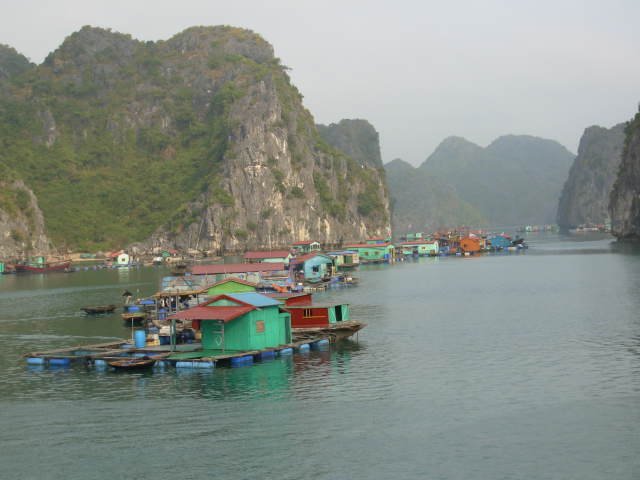
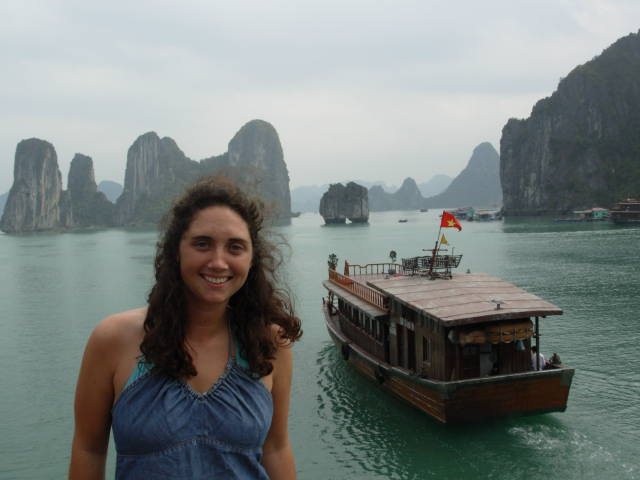
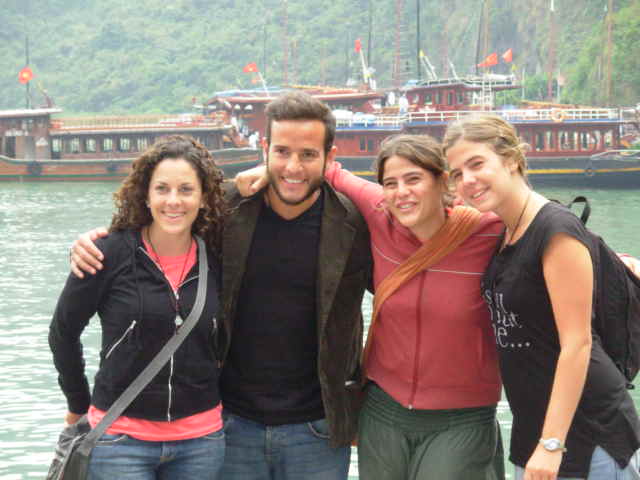
After flying from Hue to Hanoi; I met two people from Mexico City, Alejandro and Coral, on the shuttle from the airport. We immediately became good friends, and they invited me to joing them on a tour that they were doing to Halong Bay. We met up with two girls from Argentina, friends of Alejandro and Coral, and together the five of us left on a tour of the famous and beautiful Halong Bay.


From the right: Coral, Alejandro, Vicki and her sister Clara. The five of us got along really well, and it was great to be able to speak Spanish with them, as it has been awhile since I've spoken Spanish for days on end.In Halong Bay people live on these floating houses. Women would approach our bigger boat in little row boats, selling food and beverages among other things.


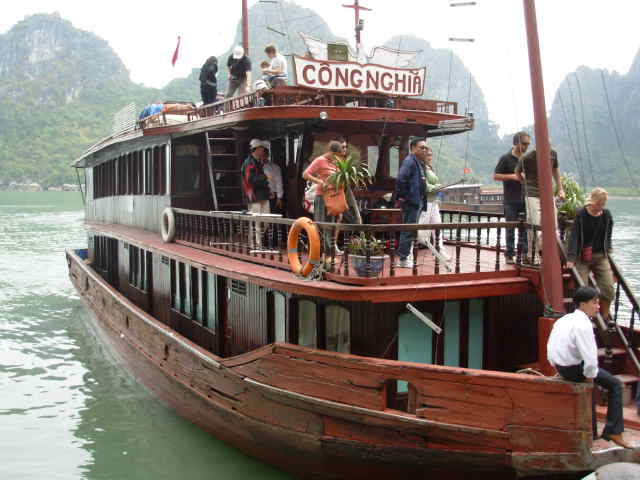
This was our boat, and I'm not sure what the name means. There were about 20 people in our tour group, but not everyone slept on the boat. About sixteen of us slept on the boat, and I shared a room with a girl named Pooja from India. Pooja and I get along really well, so we decided to share a room in Hanoi when we returned from Halong Bay. Pooja is a lawyer in Bombay, India.


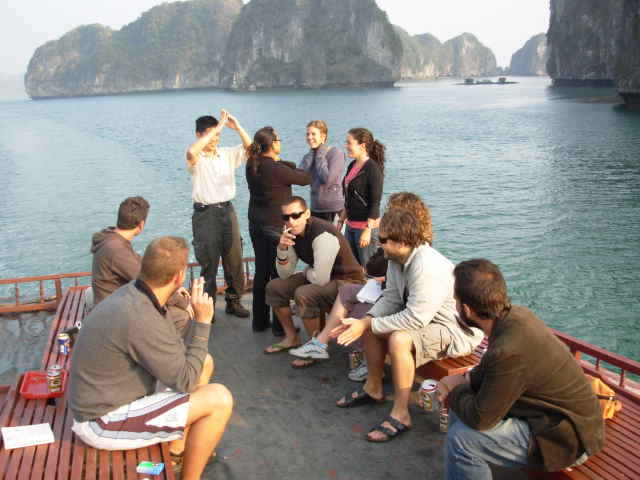
In the late afternoon as the sun was setting, we sat on the top of the boat, floating between these amazing rock formations that seemed to have grown out of the ocean. We drank some beer and stopped briefly to kayak, which was really fun! It was a great tour; I've returned to Hanoi and I will leave on a flight this evening for Kuala Lumpur, then Manil, then Hong Kong and back to Korea.